
Turn real-time product signals into higher retention, more relevant customer journeys, and sustainable revenue growth
In 2026, growth is no longer driven by broad campaigns, static funnels, or generic email flows that treat every user the same. The brands pulling ahead are the ones that respond to behavior in real time, and that is exactly why event-based marketing automation has become such a powerful strategy. Instead of guessing what users need, companies can now use real product signals to trigger relevant, timely communication that supports users at every stage of the journey.
This shift matters because customer expectations are higher than ever. People expect products to feel intuitive, communication to feel relevant, and every touchpoint to make sense. If someone signs up, explores a feature, gets stuck, and hears nothing helpful from the brand, the opportunity often disappears. But when that same moment triggers a useful nudge, a reminder, or a contextual message, the entire experience changes.
A few reasons this approach is gaining so much momentum in 2026:
- It connects product usage with marketing actions in real time
- It helps brands improve onboarding, retention, and conversion
- It reduces guesswork by using actual behavior instead of assumptions
- It allows lean teams to create more relevant customer journeys
That is why behavior-based growth is not just a passing trend. It is becoming the standard for companies that want smarter systems, stronger retention, and more efficient growth.
Understanding event-based marketing automation
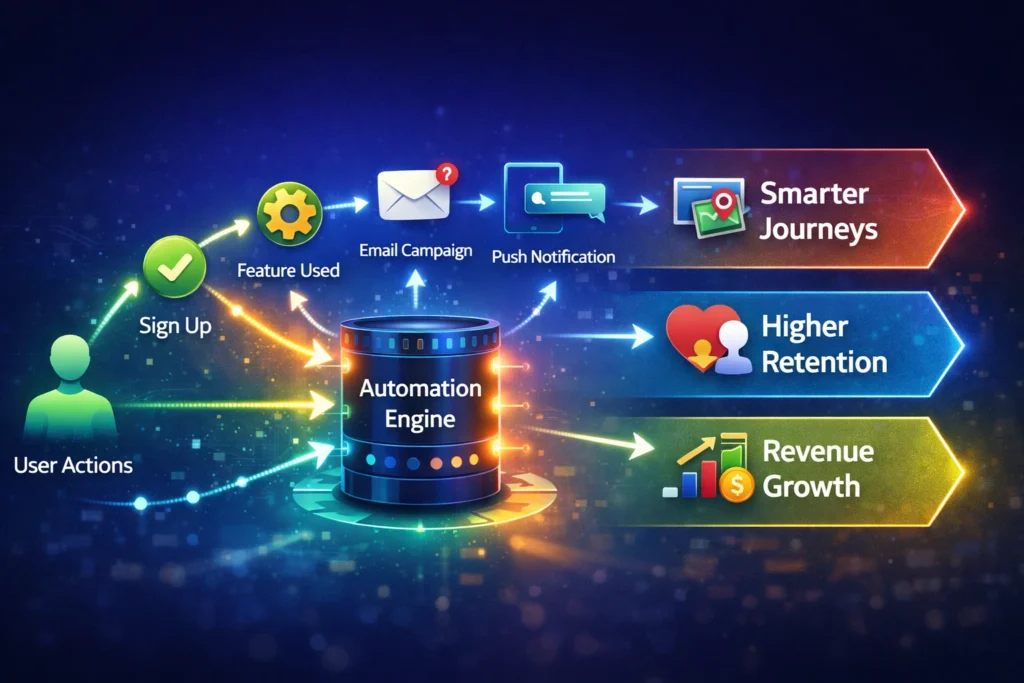
At its core, event-based marketing automation means using user behavior inside a product to trigger automated marketing actions. A product event is any meaningful action a user takes, such as signing up, completing onboarding, creating a project, inviting a teammate, trying a premium feature, or abandoning checkout. Marketing automation is what happens next, an email gets sent, an in-app message appears, a push notification is triggered, or a sales team is alerted.
When these two elements work together, marketing becomes far more intelligent. Instead of relying on fixed sequences or time-based flows alone, brands can respond to what users are actually doing. This creates a more helpful and personalized experience, because every message is tied to real context.
That context is what makes the strategy so valuable. A new user who has not completed setup needs something very different from an advanced user who is actively exploring premium functionality. Product events marketing automation makes it possible to reflect that difference automatically, at scale, without turning every campaign into a manual task.
Why Behavior-Based Growth Is Winning in 2026
The reason behavior-based growth is winning in 2026 is simple: static marketing is losing effectiveness. Audiences are overwhelmed, inboxes are crowded, and users have very little patience for irrelevant communication. Brands can no longer rely on sending the same lifecycle sequence to everyone and expect strong results.
Modern growth depends on relevance. If a user is highly engaged, your next message should help them go deeper. If they are confused or inactive, your next message should remove friction. If they are close to conversion, your communication should reinforce value and confidence. None of this works well when every user is placed into the same fixed journey.
This is exactly why product event-based marketing automation is outperforming older approaches. It allows brands to react in the moment, using real signals rather than broad assumptions. In 2026, that ability is becoming a serious competitive advantage. The companies that act on behavior faster are often the ones improving retention faster, learning faster, and growing more sustainably.
The Problem With Traditional Marketing Automation
Traditional marketing automation usually follows a calendar. A user signs up, enters a sequence, and receives messages on day one, day three, and day seven. The structure is simple, but the weakness is obvious: real user behavior rarely follows a neat timeline.
Some users activate in minutes. Some hesitate after one key action. Some explore a lot but never commit. Others disappear and come back later. A fixed sequence cannot adapt naturally to these patterns, which means timing often feels off and messages often feel disconnected from reality.
That disconnect hurts performance. When users receive content that does not match their actual stage in the journey, they are more likely to ignore it. Worse, the experience starts to feel generic. Product events marketing automation solves this by replacing rigid time-based logic with behavior-based logic. The next action depends on what the user actually did, not just how many days passed since signup.
The Process Behind event-based marketing automation
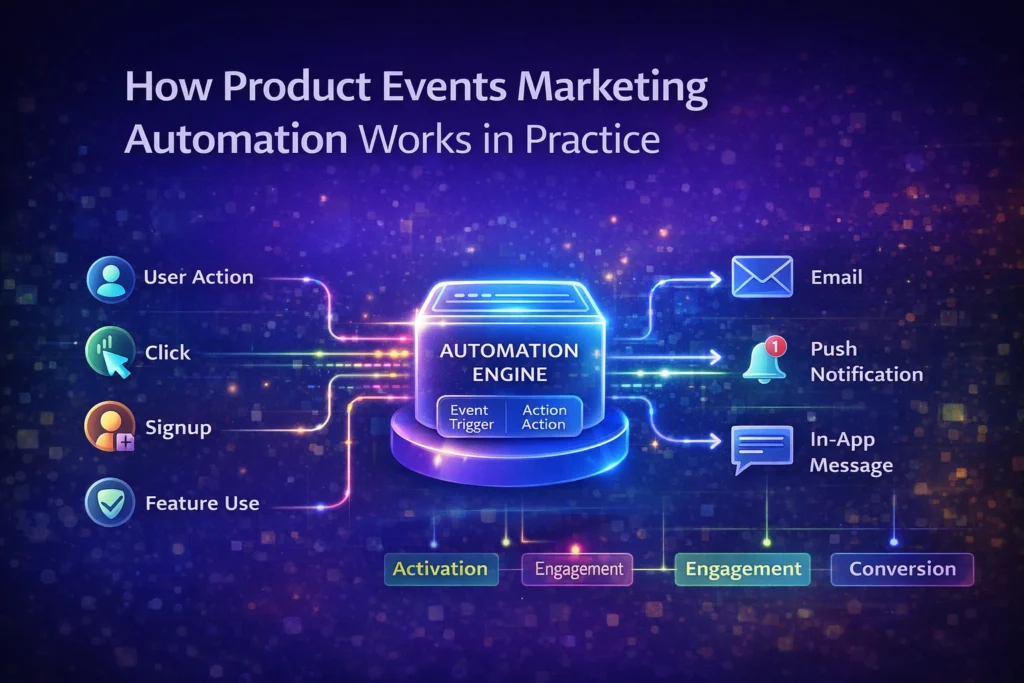
The way product events marketing automation works is easier to understand when broken into stages. First, the product tracks meaningful user actions. Then those actions are defined as events that represent intent, progress, friction, or value. After that, automation rules connect those events to specific responses.
For example, a user may sign up but fail to complete onboarding within 24 hours. That event can trigger a reminder email, a contextual in-app guide, or even a support offer. If another user completes onboarding quickly and begins using advanced features, that behavior might trigger educational content, upgrade messaging, or a product tips sequence.
The real strength of this system is that it feels dynamic. Customer journeys become responsive rather than pre-scripted. Instead of forcing people through the same path, the brand adapts based on what users are signaling through their actions.
The Product Events That Matter Most
Not every event deserves equal attention. One of the most common mistakes is tracking too many actions and then struggling to identify what truly matters. The best strategies focus on events that represent meaningful progress or friction in the user journey.
The most important event categories usually include activation, engagement, conversion, and drop-off. Activation events show that a user reached an early success moment. Engagement events reveal whether users are building habits. Conversion events indicate revenue intent or customer expansion. Drop-off events show where the journey is breaking down.
These types of events help teams create automation that is tied directly to business outcomes. Instead of reacting to random clicks, they react to moments that shape retention, monetization, and long-term loyalty.
Where Brands Usually See the Biggest Wins
In practice, most teams discover that the strongest early wins come from a few high-impact areas:
- Onboarding flows that adapt to setup progress
- Re-engagement campaigns triggered by declining activity
- Upgrade prompts based on feature usage and intent
- Abandonment recovery tied to incomplete high-value actions
These use cases work well because they sit close to moments that already matter. They do not force communication into the journey. They support users exactly where friction or opportunity already exists.
A Real Example of Behavior-Based Growth
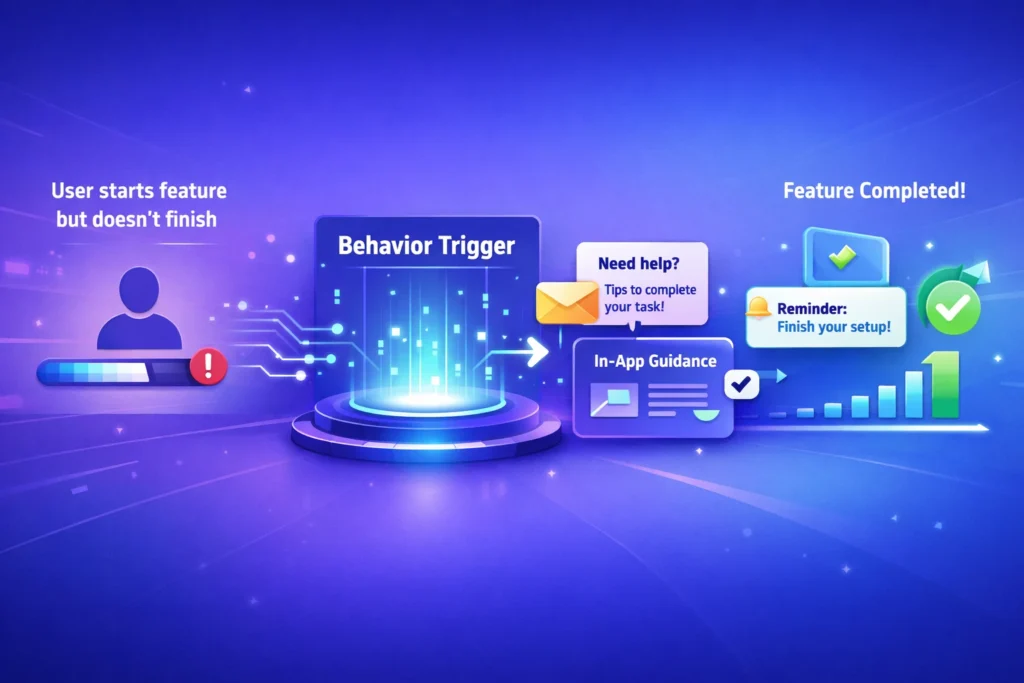
Imagine a user signs up for a SaaS product, imports data, clicks into an advanced feature, and then leaves before finishing setup. In a traditional automation system, that user might receive a general product education email two days later. The message is not necessarily wrong, but it is not particularly helpful either.
With event-based marketing automation, that same behavior creates a much smarter response. The system recognizes that the user showed interest in a valuable feature but did not complete the process. A few hours later, the user receives a short email focused specifically on that feature, explaining the next step in a clear and simple way. When they return to the product, they see an in-app prompt that helps them continue where they left off.
This kind of response feels more natural because it is tied directly to intent. The user does not feel like they were dropped into a generic nurture funnel. They feel like the product noticed what they were trying to do and helped them succeed.
The Impact of Behavior-Based Automation on Retention
Retention is often where product events marketing automation creates the biggest long-term impact. Many brands spend heavily on acquisition, only to lose users because the post-signup experience is too static or too slow to react. When users encounter friction and nothing meaningful happens, drop-off becomes much more likely.
Behavior-based automation helps teams spot warning signs earlier. If a user stops engaging with a core feature, delays activation, or reduces usage after an initial burst of interest, those signals can trigger a timely response. That response might be educational, supportive, or motivational, but the key is that it arrives before the relationship is gone.
This is one of the reasons behavior-based growth is winning in 2026. It allows companies to be proactive instead of reactive. Rather than analyzing churn after it happens, they can intervene while there is still a realistic chance to improve the outcome.
Stronger Growth Through Product and Marketing Alignment
One of the most important shifts behind event-based marketing automation is that it brings product and marketing closer together. Product teams know which behaviors signal value. Marketing teams know how to communicate that value. When those insights stay separated, customer journeys become fragmented.
When they work together, the system becomes much more powerful. Product defines the events that matter, while marketing builds messaging around those moments. Customer success and sales can also use those same signals to prioritize outreach or expansion opportunities.
This shared view of the customer creates stronger alignment. Instead of each team interpreting the journey differently, everyone is working from the same behavioral data. That improves not just campaigns, but strategic decision-making across the business.
Common Mistakes to Avoid
Even though the concept is powerful, execution can fail when the setup is too messy or too aggressive. One common mistake is tracking too many low-value events. That creates noise, makes prioritization harder, and often leads to weak automation logic.
Another problem is over-automation. Just because a system can react to every event does not mean it should. If users receive too many messages, the experience starts to feel noisy rather than helpful.
A third mistake is confusing activity with progress. A lot of clicking does not always mean a user is moving closer to value. The best event strategies focus on actions that represent real milestones, meaningful intent, or clear friction. That is what makes automation feel useful rather than random.
Start Simple: Build Product Events Marketing Automation Without Overcomplicating It
The best way to start is with a small number of meaningful events. A company does not need an enormous event taxonomy from day one. In fact, starting smaller usually leads to better results because the strategy stays focused.
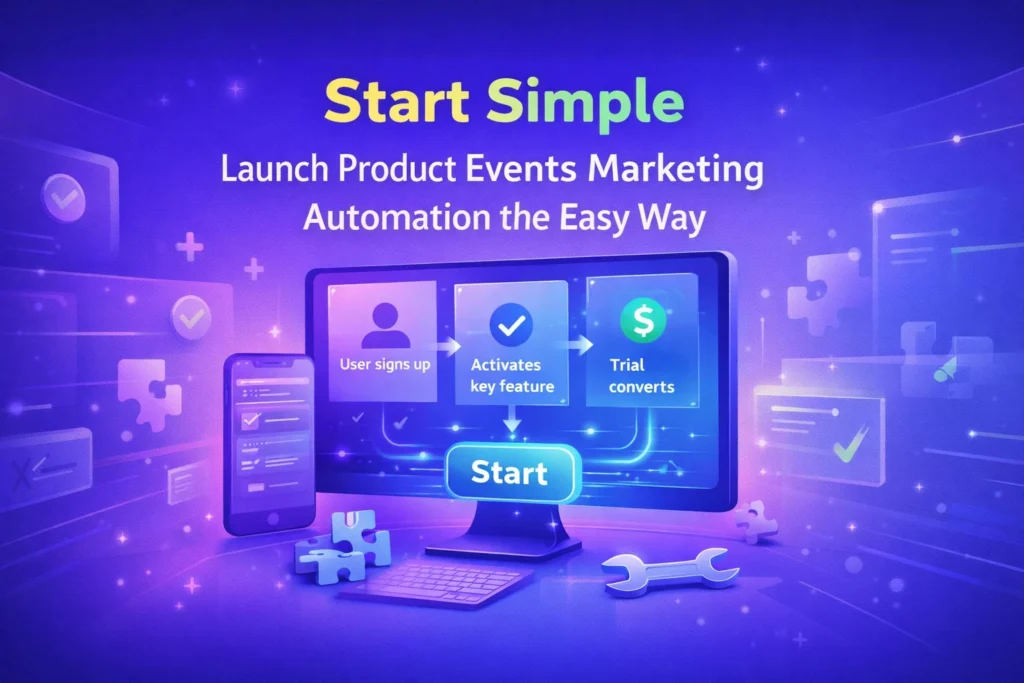
For many teams, the first useful events include account creation, onboarding completion, first key action, feature adoption, trial-to-paid conversion, and inactivity. These moments are enough to create an onboarding flow, a re-engagement flow, and a conversion-support flow. That already covers a large part of the customer journey.
Once those foundations are working, the system can expand. Teams can refine trigger logic, improve segmentation, test new channels, and add more advanced use cases. The goal is not to build everything immediately. The goal is to build a system that learns and improves over time.
Your Questions Answered
Product events marketing automation is the process of using meaningful user actions inside a product to trigger automated marketing responses. These actions can include signup, onboarding completion, feature usage, inactivity, or upgrade intent. The goal is to make every message more relevant and better timed, so users receive support or prompts based on what they are actually doing.
Behavior-based growth is winning in 2026 because generic campaigns are becoming less effective and user expectations are rising. Customers expect digital experiences to feel timely, relevant, and personalized. Brands that use live product signals can respond faster, improve retention, and create smarter customer journeys than brands still relying on static marketing flows.
Traditional automation usually depends on schedules, broad segments, or fixed sequences that send the same messages to large groups of users. Product events marketing automation reacts to actual behavior, which makes it more adaptive and more context-aware. That means messaging changes depending on what a user has done, what they skipped, or where they are stuck.
Most companies should begin with events that reflect activation, engagement, conversion, and drop-off. Strong early examples include account creation, onboarding completion, first key action, feature usage milestones, trial-to-paid conversion, and inactivity. Starting with a focused set of high-impact events makes it much easier to build automation that is both useful and measurable.
Some results can appear fairly quickly, especially in onboarding and re-engagement flows where improvements are easier to measure. Retention and revenue impact often take longer because they develop over time and depend on user behavior across a longer lifecycle. The best approach is to start with a few core workflows, measure carefully, and optimize continuously rather than trying to launch a perfect system all at once.
Final Thoughts
In 2026, the companies growing most effectively are not the ones sending more messages. They are the ones sending smarter messages, at better moments, based on real behavior. That is exactly why product events marketing automation is becoming such a critical growth strategy.
It turns raw product data into meaningful customer communication. It helps users move forward when they are stuck, helps teams react earlier to churn risk, and helps brands create journeys that feel more useful and more human. In a crowded digital environment, that kind of relevance is no longer just a nice advantage, it is becoming the baseline for serious growth.
