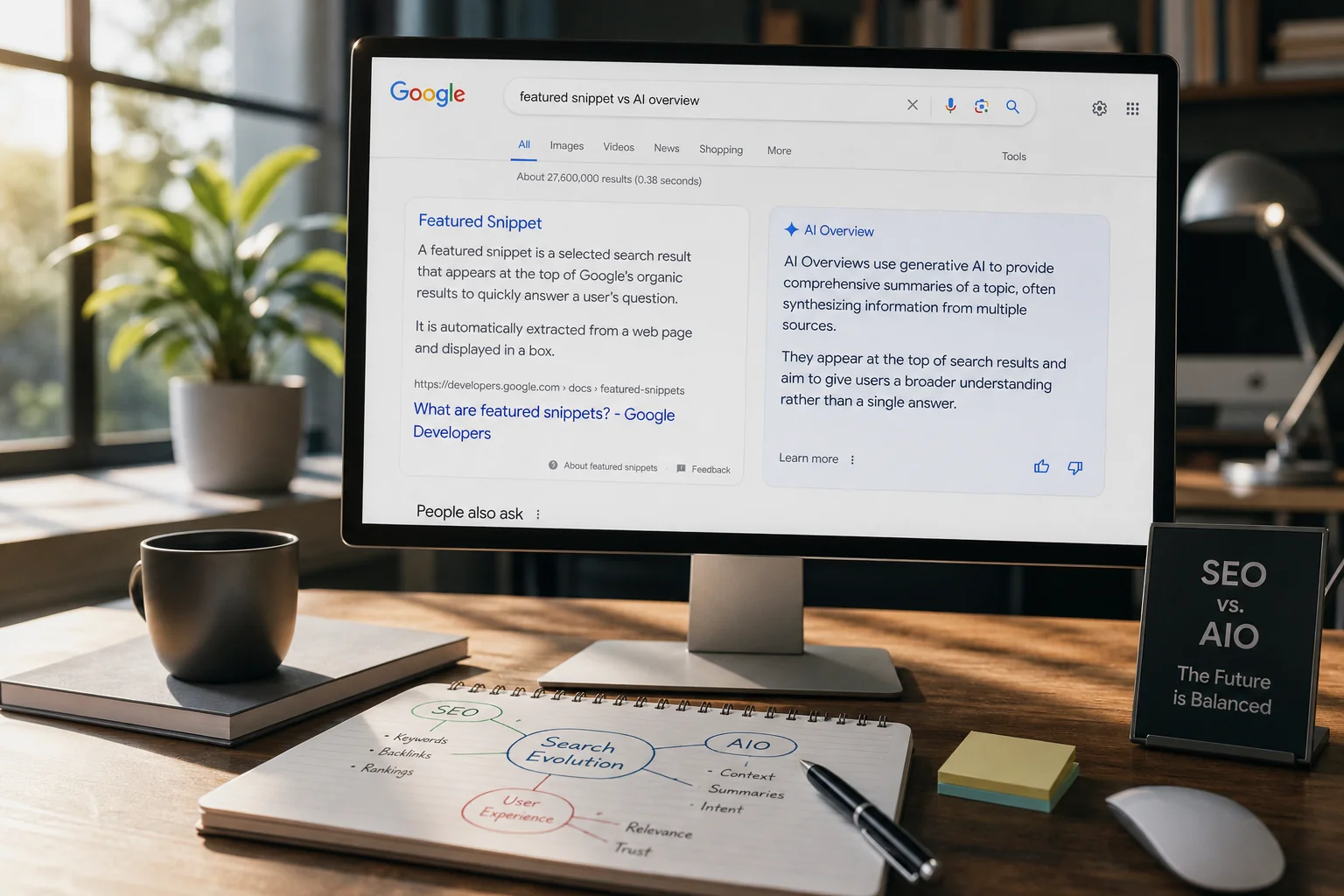
AI Overviews vs Featured Snippets: What’s the Difference for SEO?
Discover the differences between AI overviews vs featured snippets and their impact on SEO strategies.
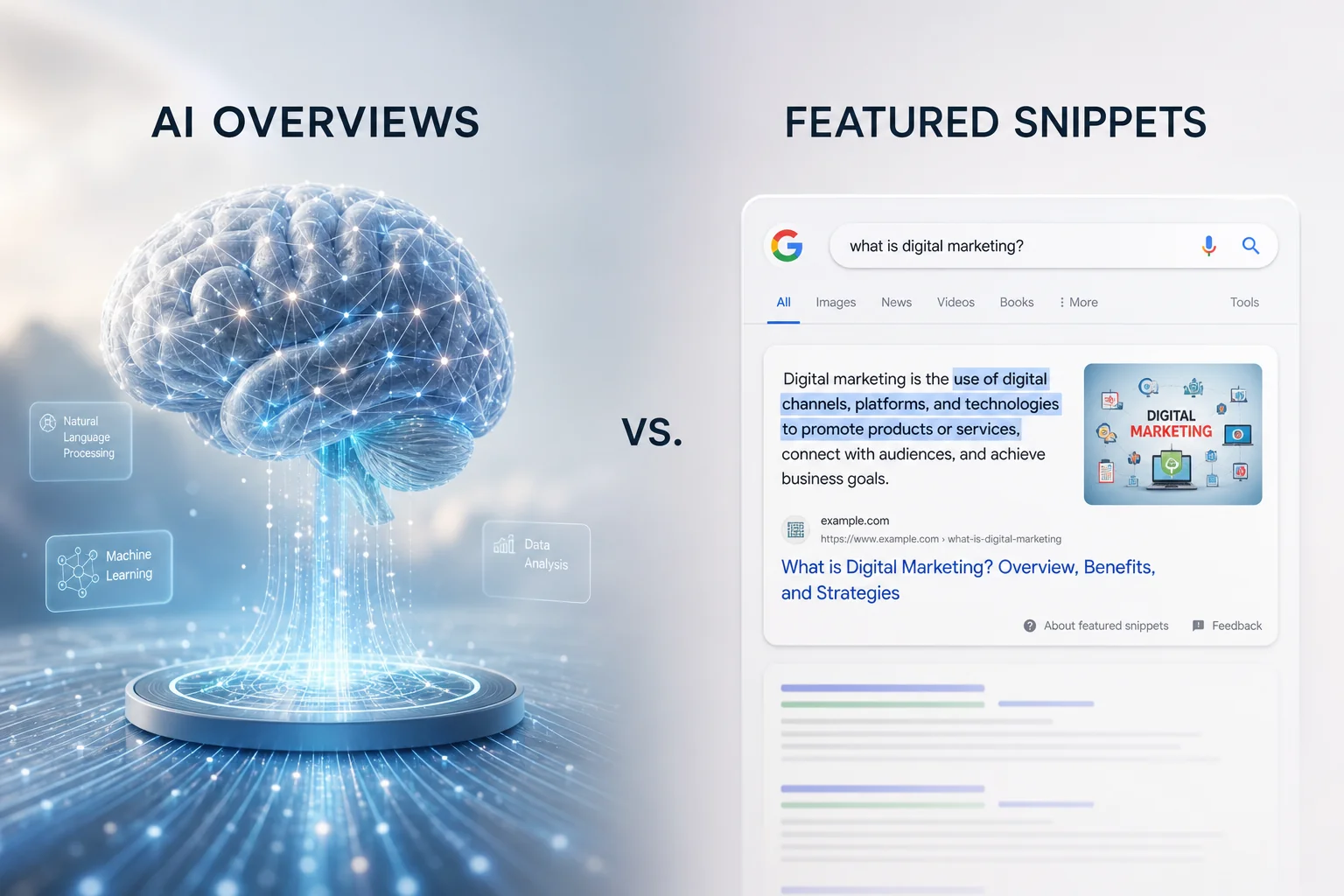
AI Overviews vs Featured Snippets and
What They Mean for Search Visibility
Understanding AI Overviews vs Featured Snippets matters because both can occupy highly visible positions in Google Search, but they work in fundamentally different ways. A Featured Snippet typically highlights information from a specific webpage, while an AI Overview can synthesize information from multiple sources to answer a broader or more complex query.
For marketers, SEO teams, agencies, and business owners, the practical question is not which format will replace the other. It is how to create content that remains useful across both traditional and AI-assisted search experiences.
In this guide, you will learn:
- How AI Overviews differ from Featured Snippets
- What each format means for organic visibility
- How content can support both search experiences
- Which optimization tactics are useful and which are overhyped
What Google AI
Overviews Actually Do
AI Overviews are generative responses that Google can display for searches where a synthesized answer may help users understand a topic more quickly.
Instead of simply extracting one section from one webpage, the system can retrieve information relevant to different aspects of the query and generate a response supported by links to web sources.
This is particularly useful for questions that cannot be answered well with one short paragraph.
Imagine someone searching for the best attribution approach for an international ecommerce business. A useful response may need to consider analytics platforms, attribution models, privacy, CRM integration, paid media, conversion tracking, and the company's sales cycle.
An AI Overview can potentially bring several of those perspectives together.
Google explains in its official documentation for AI features in Search that AI Overviews and AI Mode can use techniques such as query fan-out to search across related subtopics and data sources. Importantly, Google also states that the same core SEO requirements continue to apply. There is no separate technical shortcut that guarantees inclusion in an AI-generated response.
This is closely connected to the broader question of how AI search engines decide what to cite. A page needs to provide information that is useful within the specific retrieval context, not merely rank for a broadly related keyword.
How Featured Snippets Work
Featured Snippets are a more established Google Search feature.
They typically extract a concise piece of information from a webpage and display it prominently within the search results. Depending on the query, the answer may appear as a paragraph, list, definition, table, or similar format.
A query such as "what is customer lifetime value?" can often be answered directly. If a webpage provides a concise, relevant definition, Google may choose that section for a Featured Snippet.
The relationship between the source and answer is therefore comparatively straightforward. Google is highlighting content from a particular page.
Featured Snippets are particularly useful for specific informational searches where the user's intent can be addressed quickly.
That does not mean the page should contain only a short answer. Strong content usually provides the direct response first and then develops the topic in enough detail to satisfy users who need more context.
AI Overviews vs Featured
Snippets: The Core Difference
The most important distinction in AI Overviews vs Featured Snippets is how the response is constructed.
Featured Snippets usually surface a specific answer from a particular webpage. AI Overviews can synthesize a broader response based on information relevant to several parts of the user's question.
This changes the opportunity for publishers.
A page does not necessarily need to answer the entire AI-generated question to become useful. It might provide the clearest explanation of one technical issue, an important limitation, a useful comparison, or a particularly relevant piece of evidence.
Consider a query about whether a company should increase paid media investment.
The final AI-generated response might need information about conversion rates, attribution, customer acquisition cost, profitability, customer lifetime value, and retention. Several different pages could therefore contribute useful context.
That is one reason modern SEO increasingly overlaps with AI search optimization for platforms such as ChatGPT, Gemini and Perplexity. Strong search content needs enough clarity to answer focused questions while also providing the depth necessary for more complex research.
What AI Overviews
Change for SEO
Traditional ranking remains important, but generative search creates additional ways for content to surface.
A website may appear as a supporting source inside an AI-generated answer even though users are not interacting with a conventional list of ten blue links in the same way.
This makes topical relevance more important.
A highly authoritative page may rank well for a broad keyword, but another source may contain a more useful passage for one specific component of an AI query.
For example, an article about conversion tracking may rank for the broad subject. But if a user asks why Meta Ads and GA4 report different purchase totals, a page that directly explains attribution windows, event deduplication, consent, and reporting differences may be more useful to the generated response.
This does not invalidate traditional SEO. It expands the range of questions a page may need to answer.
For businesses trying to understand whether that broader visibility is improving, tracking brand visibility across ChatGPT, Perplexity and Gemini can provide useful context alongside conventional ranking and traffic reporting.
Featured Snippets Still
Have Strategic Value
It would be a mistake to assume AI Overviews have made Featured Snippets irrelevant.
Many searches still benefit from direct answers. Definitions, calculations, short processes, comparisons, and factual questions can all produce traditional search features.
Featured Snippets also reward a content-writing principle that remains valuable regardless of Google's interface: answer the question clearly.
If a section is called "What is server-side tracking?", the first paragraph should actually define server-side tracking. It should not spend three paragraphs discussing how digital marketing has changed before reaching the answer.
After the concise response, the content can explain how server-side tracking works, when businesses use it, what its limitations are, and how it compares with browser-side tracking.
This structure improves readability and gives search systems clearer information to interpret.
How to Optimize
for Both Search Experiences
Businesses do not need two completely separate content strategies.
A strong page can support Featured Snippets, conventional organic rankings, and AI-assisted discovery when its information architecture is designed around real user needs.
Focus on five things:
- Give direct answers where the search intent calls for them
- Develop important topics with enough depth to answer follow-up questions
- Use descriptive headings that accurately represent each section
- Support factual claims with reliable evidence where appropriate
- Connect relevant supporting pages through logical internal links
This is also why a strategic content marketing approach matters more than simply increasing publishing volume. Content should build connected expertise around the subjects customers actually research rather than consist of isolated posts written only to capture individual keywords.
Schema markup can support machine understanding where appropriate, but it should not be treated as a special AI Overview switch. There is no schema type that guarantees inclusion in Google's generative search features.
Likewise, simply adding more FAQs or repeating question-style headings does not automatically improve AI visibility.
Useful information remains the core requirement.
Depth Matters Because AI
Queries Can Be More Specific
One difference between traditional keyword research and AI-assisted discovery is the complexity of the questions users can ask.
Someone using a conventional search engine might type:
"best CRM for agency"
An AI-assisted query could instead be:
"What CRM would suit a 15-person marketing agency that manages long sales cycles, needs Google Ads attribution and wants to avoid an expensive enterprise setup?"
The second query contains several dimensions.
A generic CRM list may be insufficient. A page that discusses business size, attribution requirements, integrations, pricing, implementation complexity, and reporting may offer more useful material.
This does not mean publishers should create hundreds of pages targeting every imaginable prompt.
It means the best resources should reflect the questions real buyers ask after the initial search.
The Mass Data GEO case study on AI visibility provides a useful example of why AI search performance needs to be considered across content, technical signals, structured information, and entity clarity rather than reduced to one optimization tactic.
A Practical Example:
One Page, Two Opportunities

Imagine a SaaS company publishes a detailed article about customer lifetime value.
One section is headed "How do you calculate customer lifetime value?"
The paragraph directly below provides the calculation and briefly explains the variables.
That section is well suited to a traditional snippet-style result because it gives a concise answer to a specific question.
The same article then explores how churn affects lifetime value, how different customer segments should be evaluated, how acquisition cost changes profitability, and why subscription and ecommerce businesses may interpret the metric differently.
Now imagine someone searches:
"Should an ecommerce company increase acquisition spend if repeat purchases are falling?"
A useful AI response could require information about acquisition cost, CLV, retention, churn, profitability, and repeat purchase behaviour.
The article may provide useful information for one component of that larger answer.
The page has not been written twice. It simply combines a clear answer with meaningful depth.
That is the most practical way to think about AI Overviews vs Featured Snippets. Different search formats can reward different parts of the same strong resource.
Common Mistakes When
Optimizing for Search Features
One mistake is believing you can directly create an AI Overview. You cannot. You create web content, and Google determines when an AI Overview is useful and which sources should support it.
The same principle applies to Featured Snippets. You can structure content effectively, but you cannot force Google to select it.
Another mistake is producing large volumes of shallow content designed around slightly different versions of the same question. That may generate more URLs without creating more useful information.
Businesses also sometimes rely too heavily on schema or formatting. Structured data, headings, lists, and technical SEO all have legitimate roles, but none replaces substantive content.
A final mistake is judging success exclusively by whether a page becomes an AI source. Organic rankings, qualified traffic, conversions, brand visibility, citations, and commercial outcomes all matter.
Measuring Search Visibility
as the SERP Evolves
Search measurement is becoming more multidimensional.
Traditional SEO metrics remain useful. Search Console can show impressions, queries, clicks, positions, and pages. Analytics can help determine what visitors do after reaching the website.
AI visibility adds another layer.
You may want to understand which pages are cited, which subjects generate brand mentions, which competitors repeatedly appear, and whether your company is associated with the right expertise.
Do not judge progress from one manually tested prompt.
Instead, use a stable group of commercially meaningful queries and monitor them over time. This makes it easier to identify whether visibility is improving consistently or whether an isolated result was simply a one-off response.
The commercial value of this visibility should also remain central. For companies that want to connect SEO, AI discovery, acquisition, analytics, and conversion into one framework, Mass Data's growth marketing services focus on measurable business outcomes rather than search visibility in isolation.
Conclusion
Understanding AI Overviews vs Featured Snippets helps clarify how Google Search is evolving without creating a false choice between traditional SEO and AI optimization.
Featured Snippets remain valuable for concise, specific answers. AI Overviews can address broader questions by combining information relevant to several aspects of a user's search.
For businesses, the strongest response is to improve the usefulness of the underlying content. Answer important questions clearly, develop the subject beyond superficial summaries, support claims appropriately, build connected topical expertise, and keep the technical foundation strong.
The interface may continue to change, but useful information remains the asset that every search experience ultimately depends on.
Questions
Answered
Common questions related to this topic.
What is ai overviews vs featured snippets?
AI overviews provide a general summary of a topic generated by artificial intelligence, while featured snippets are specific excerpts from web pages that directly answer user queries. For instance, a featured snippet might pull a definition from a webpage, whereas an AI overview would provide a broader context of that definition.
How do AI overviews vs featured snippets impact SEO?
Both AI overviews and featured snippets can enhance visibility on search engines, but they serve different purposes. Featured snippets can directly increase click-through rates by presenting concise answers at the top of search results, while AI overviews can help users gain a deeper understanding of a topic, potentially leading to longer engagement.
Why are featured snippets important for my website's SEO?
Featured snippets can significantly increase your website's visibility and traffic by placing your content at the top of search results. This prominence not only attracts more clicks but also establishes authority in your niche, leading to higher trust among users.
Can AI overviews improve my content strategy?
Yes, integrating AI overviews into your content strategy can enhance user experience by providing comprehensive information about a topic. This helps attract visitors who are looking for thorough insights, positioning your brand as a knowledgeable resource.
When should I target featured snippets over AI overviews?
You should target featured snippets when your content can provide clear, direct answers to common user queries. If your goal is to enhance immediate visibility and drive traffic, optimizing for featured snippets is often more effective than focusing solely on AI overviews.
Should I use both AI overviews and featured snippets in my SEO strategy?
Absolutely. Combining both AI overviews and featured snippets can create a well-rounded SEO strategy. AI overviews can engage users seeking in-depth information, while featured snippets can capture users looking for quick answers, thus maximizing your content’s reach and effectiveness.
Ready To GrowThis Into Results?
Discover the differences between AI overviews vs featured snippets and their impact on SEO strategies.
Prefer to reach out directly? We'll get back to you as soon as possible.
Contact MASS DATA Today