MASS DATA — AI Search Optimization (GEO)

Customer Churn Reduction Ecommerce Strategies That Drive Repeat Sales

Discover effective email flows for customer churn reduction in ecommerce and boost retention rates.

A diverse group of happy shoppers enjoys a modern e-commerce store, highlighting personalized service and community engagemen

Customer Churn Reduction Ecommerce: Build Email
Flows That Keep Buyers Coming Back

Effective customer churn reduction ecommerce strategy is not just about sending more emails or offering another discount. Ecommerce churn often happens quietly: a customer makes one purchase, stops engaging, and never returns. Without a subscription cancellation event, the business may not even notice that the relationship has ended.

The better approach is to use purchase behaviour, lifecycle timing, segmentation, and automated communication to identify when customers are drifting away and create relevant reasons to return.

In this guide, you will learn:

  • Which ecommerce behaviours can indicate churn risk
  • Which email flows support retention beyond the first purchase
  • How cart abandonment differs from customer churn
  • How to measure whether retention work is actually improving repeat revenue

What Customer Churn
Means in Ecommerce

Customer churn is easier to define in a subscription business because the customer usually cancels or fails to renew. Ecommerce is different.

A customer can technically remain in your database for years while having no intention of purchasing again. This means ecommerce businesses need a practical definition of inactivity.

For one store, a customer who has not purchased for 60 days may be at risk. For another business selling products with a much longer replacement cycle, 60 days may be completely normal.

The first step in customer churn reduction ecommerce is therefore understanding the natural purchase rhythm of the business.

Look at how long customers usually wait between their first and second orders. Compare repeat buyers with one-time purchasers. Examine whether purchasing frequency differs by product category, acquisition source, order value, or customer segment.

This gives you a much stronger foundation than simply deciding that every customer who has not purchased recently has churned.

Mass Data's guide to reducing customer churn without damaging the customer experience provides broader context for building retention around genuine customer value rather than aggressive save tactics.

Map the Retention Problem
Across the Ecommerce Lifecycle

Not every lost ecommerce customer has the same problem.

Some customers disappear before buying. Others complete a first order but never return. Some purchase repeatedly and then gradually become inactive.

These are different stages of the lifecycle and require different interventions.

Cart abandonment occurs before the customer completes a transaction. Post-purchase churn concerns customers who already bought but fail to develop into repeat buyers. Re-engagement focuses on customers whose previous purchase behaviour suggests they should have returned by now.

Treating all three groups as one "churn audience" makes email communication much less relevant.

A customer who abandoned a €200 basket yesterday needs a different message from someone who bought the same product six months ago and has not returned.

Your retention model should therefore reflect where the customer is in the journey, what they have already done, and what behaviour would represent the logical next step.

Email Flows That Support
Customer Churn Reduction Ecommerce

Automated email flows are useful because retention communication can be triggered by behaviour rather than sent according to a generic newsletter calendar.

The most important flows usually begin immediately after acquisition.

A welcome sequence can explain what makes the brand different and guide subscribers toward relevant products. Post-purchase communication can set expectations, provide product guidance, gather feedback, and introduce complementary products without immediately pushing another sale.

As the customer moves further from the initial transaction, email can respond to inactivity or expected repurchase timing.

A practical lifecycle often includes:

  • Welcome communication tailored to the customer's acquisition source or interest
  • Post-purchase messages that support product use and satisfaction
  • Cross-sell or replenishment flows based on previous purchase behaviour
  • Re-engagement messages triggered when normal purchasing activity declines
  • Win-back communication for customers showing stronger signs of inactivity

The objective is not to create the largest possible automation map. Each flow should have a clear reason to exist.

Mass Data's MNX Sportswear ecommerce case study shows how checkout email capture and subsequent engagement can become part of a wider retention system rather than a one-time conversion tactic.

Cart Abandonment Is Important, but It
Is Not the Same as Churn
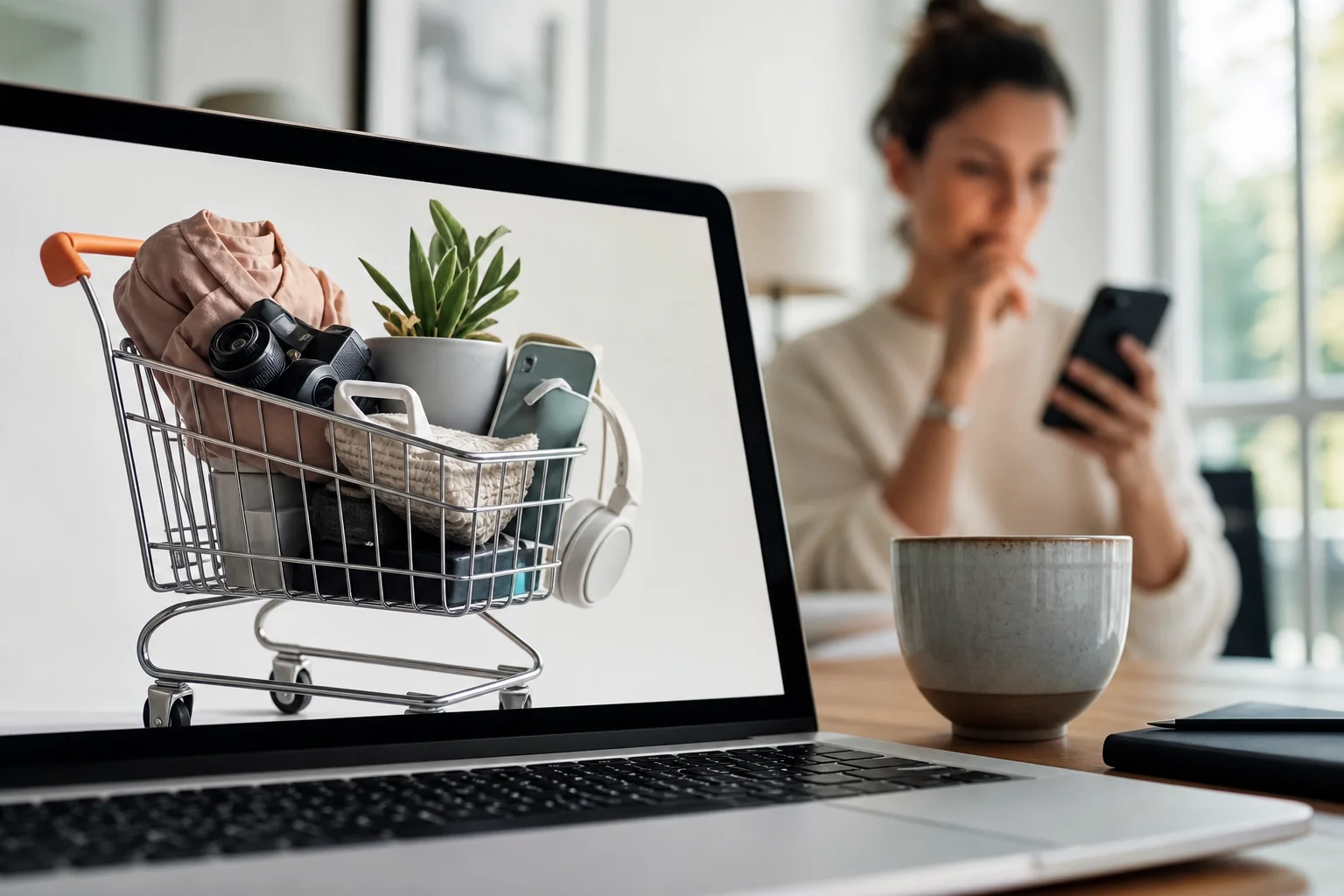
Close-up of a shopping cart on a screen, showcasing stylish products, with a shopper pondering in the background, bathed in w

Cart abandonment receives significant attention in ecommerce because the potential revenue loss is immediately visible.

Someone selected a product, demonstrated purchase intent, and then left.

Recovering some of those transactions makes commercial sense, but cart abandonment should not be confused with customer retention.

A shopper who has never purchased is not yet a retained customer.

This distinction matters because an ecommerce business can become very good at recovering abandoned carts while still having poor repeat purchase behaviour.

Cart recovery emails should therefore sit inside a wider lifecycle strategy.

The first reminder can simply help customers resume the checkout. Later communication might address a likely hesitation such as shipping, returns, product information, or support. Discounts should be used selectively rather than automatically training shoppers to abandon carts in anticipation of an offer.

The broader lesson from the LanaShoes ecommerce retention case study is that capturing high-intent visitors becomes more valuable when the business can continue communicating with them after that initial checkout moment.

Personalization and Segmentation
Make Retention More Relevant

Generic retention emails often fail because they ignore what the business already knows about the customer.

Someone who repeatedly buys running shoes should not receive the same re-engagement message as a customer who purchased formal footwear once.

Useful segmentation can be based on product category, order frequency, average order value, recency, purchase history, engagement, geography, or acquisition source.

You can then adjust timing and content accordingly.

A frequent customer whose normal purchase interval has passed may need a simple reminder. A high-value customer showing declining engagement may warrant a more personalized incentive. A first-time buyer may still need education and trust-building before another offer makes sense.

This is where customer churn reduction ecommerce becomes more sophisticated than "send a win-back email after 90 days."

The timing should follow customer behaviour.

Personalization also does not have to mean creating hundreds of micro-segments. Start with the differences that materially change what the customer should receive.

For brands that need a broader data-led retention framework, Mass Data's customer churn reduction and retention service combines segmentation, churn analysis, predictive modelling, lifecycle communication, automation, and performance measurement.

Measure Repeat Behaviour,
Not Just Email Engagement

Open rates and click-through rates can help diagnose email performance, but neither is the ultimate retention metric.

An email campaign can achieve excellent engagement without increasing repeat purchasing.

For customer churn reduction ecommerce, measurement should move further down the funnel.

Track repeat purchase rate, purchase frequency, time between orders, customer lifetime value, reactivation rate, revenue from returning customers, and cohort retention.

Cohort analysis is especially useful because it lets you compare groups of customers over time.

Cohort analysis in most analytics platforms lets you group users according to shared characteristics, such as their acquisition period, and then track their return behaviour over time. This can help ecommerce teams compare customers acquired during different periods and examine whether retention is improving.

For example, if customers acquired after a new onboarding sequence make their second purchase sooner than customers from previous cohorts, that may indicate the lifecycle strategy is moving in the right direction.

Email-platform revenue should also be interpreted carefully. Attribution rules can make the platform appear to have influenced more or fewer purchases than another analytics system reports.

What matters is whether retained cohorts become more valuable over time.

A Hypothetical
Ecommerce Retention Scenario

A modern e-commerce office with a sleek desk, laptop, mood boards, and greenery, radiating innovation in skincare retail.

Consider a hypothetical online skincare retailer.

The company is acquiring customers successfully through Meta and Google Ads, but profitability is under pressure. First-order revenue looks healthy, yet many customers never return.

The marketing team initially considers increasing discount frequency.

Instead, it analyzes purchase history.

The data shows that customers who purchase a particular starter product and place a second order within 45 days have much stronger long-term value than those who make only one purchase.

The company redesigns its lifecycle communication around that behaviour.

Immediately after purchase, customers receive product-use guidance rather than another sales offer. Later emails introduce complementary products based on what they bought. As the likely repurchase window approaches, the messaging becomes more product-specific.

Customers who pass the normal repeat-purchase window without ordering enter a re-engagement sequence.

The team then compares new cohorts with previous customers.

If second-purchase rates increase, the business has improved retention without automatically discounting every customer.

That is a realistic customer churn reduction ecommerce strategy because the intervention is tied to observed customer behaviour rather than an arbitrary email schedule.

Mass Data's Bolerodrink.si ecommerce case study provides another example of connecting checkout intervention with email acquisition and later engagement rather than viewing the transaction in isolation. 

Common Ecommerce Retention Mistakes

One common mistake is assuming that more email automatically means better retention.

Frequency cannot compensate for irrelevance.

Another is placing every inactive customer into the same win-back sequence. Someone who purchased twice last month and then paused behaves differently from someone whose last purchase was a year ago.

Discount dependence is another risk.

A coupon can create urgency, but if every retention flow immediately offers money off, customers may learn that disengagement produces a better price.

Businesses also focus too heavily on email metrics while ignoring customer economics. A flow that produces clicks but attracts mainly discounted low-margin purchases may not be improving lifetime value.

Finally, brands sometimes invest aggressively in acquisition while failing to examine why first-time buyers do not return.

The LanaShoes case study on email acquisition and repeat engagement demonstrates why retention opportunities can sometimes be found within traffic the business is already paying to acquire. 

Build Retention Into
Your Growth Model

Ecommerce retention should not operate as a separate email project.

Acquisition, checkout, post-purchase experience, customer service, merchandising, email, and analytics all influence whether someone buys again.

That also means churn can expose problems elsewhere in the business.

A segment may stop buying because products are frequently unavailable. Another may be disappointed with delivery. Customers from a particular advertising campaign may churn because the acquisition message creates unrealistic expectations.

Retention analysis can therefore improve acquisition strategy as well.

If one advertising source produces customers with a slightly higher acquisition cost but much stronger repeat purchasing, it may ultimately be more profitable than the cheapest source of first orders.

This is why customer lifetime value and cohort performance should eventually inform media and growth decisions.

For ecommerce businesses ready to connect retention with acquisition, analytics, advertising, and profitability, Mass Data's growth marketing services focus on the full customer lifecycle rather than isolated channel metrics.

Conclusion

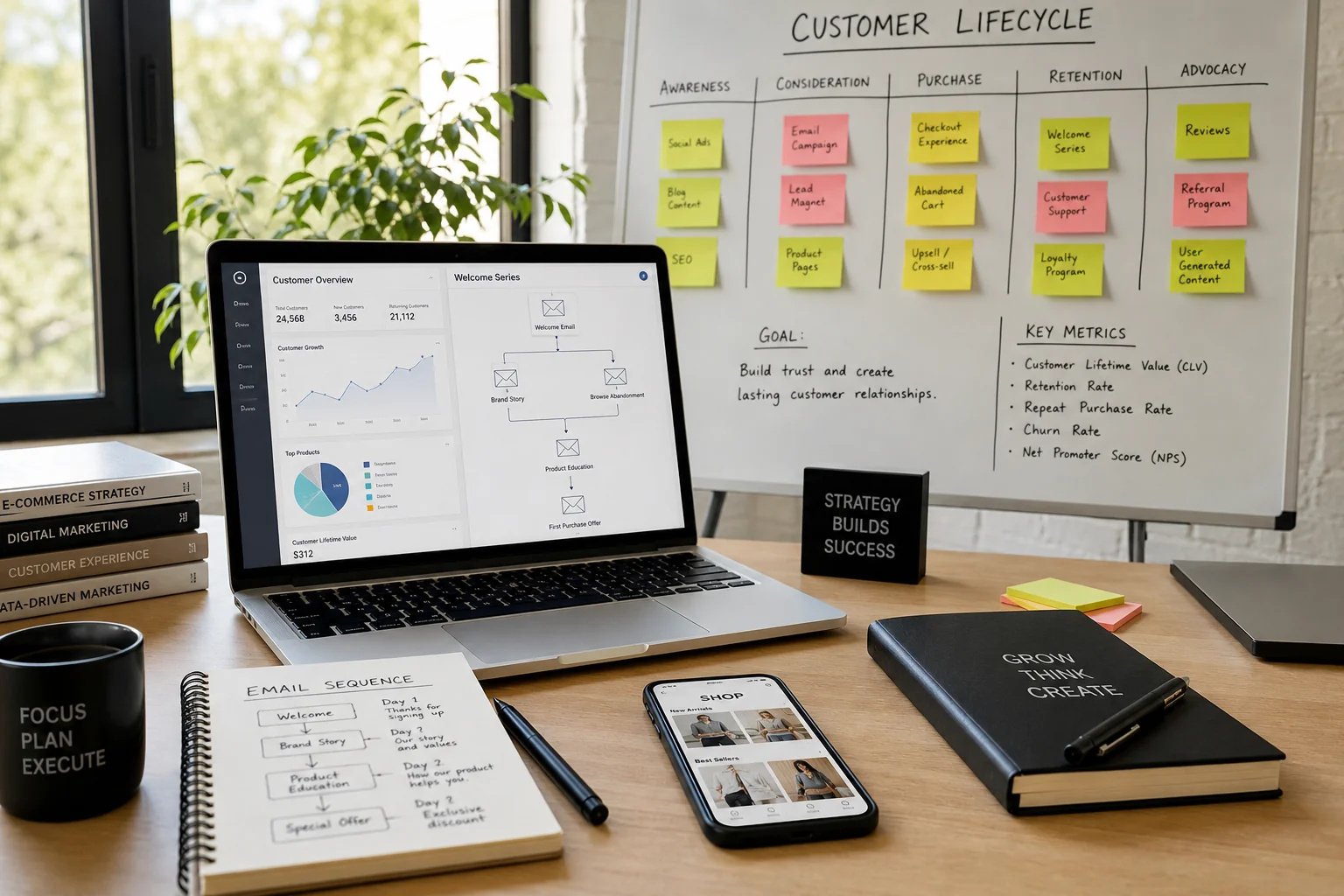
A modern workspace with a laptop, notepad, and smartphone, highlighting e-commerce strategies and customer engagement.

Effective customer churn reduction ecommerce strategy starts with understanding when and why buyers stop returning.

Email flows can play an important role, but only when they reflect real customer behaviour. Welcome sequences, post-purchase education, cart recovery, replenishment reminders, re-engagement, and win-back communication should each solve a specific lifecycle problem.

The bigger opportunity is to connect those flows with customer segmentation, repeat-purchase data, cohort analysis, and lifetime value.

When retention becomes part of the wider growth system, ecommerce businesses can stop relying exclusively on acquiring more first-time buyers and start generating more value from the customers they have already won.

Questions
Answered

Common questions related to this topic.

What is customer churn reduction ecommerce?

Customer churn reduction in ecommerce refers to strategies aimed at decreasing the number of customers who stop purchasing from your online store. These strategies can include personalized email marketing, loyalty programs, and customer engagement initiatives. By implementing effective retention tactics, businesses can enhance customer loyalty and increase repeat sales.

How do email flows help in customer churn reduction ecommerce?

Email flows reduce customer churn by sending automated, targeted messages that engage customers based on their behavior. For instance, a cart abandonment email can remind customers of their unfinished purchases, encouraging them to complete the transaction. This personalized approach fosters a stronger connection with customers, leading to higher retention rates.

Why is segmentation important in reducing customer churn?

Segmentation is crucial because it allows businesses to tailor their marketing efforts to specific customer groups based on behavior or preferences. By sending relevant content to different segments, such as special offers for frequent buyers or re-engagement emails for inactive users, businesses can effectively address the unique needs of each group, thereby reducing churn.

Can automation improve my ecommerce email flows?

Yes, automation can significantly enhance ecommerce email flows by ensuring timely and relevant communication with customers. Automated triggered emails, like welcome messages or re-engagement campaigns, provide personalized experiences without the need for constant manual input. This efficiency can lead to improved customer satisfaction and retention.

When should I focus on cart abandonment emails?

Focusing on cart abandonment emails is essential immediately after a customer leaves items in their cart without completing a purchase. Sending a reminder email within a few hours can significantly increase the chances of conversion. This quick follow-up shows customers that you value their interest and encourages them to finalize their purchase.

What metrics should I track to measure customer churn reduction success?

To measure the success of customer churn reduction efforts, track key metrics such as customer retention rate, repeat purchase rate, and the effectiveness of email campaigns (open and click-through rates). Analyzing these metrics will provide insights into customer behavior and help refine strategies to retain more customers efficiently.

Free Strategy Call

Ready To GrowThis Into Results?

Discover effective email flows for customer churn reduction in ecommerce and boost retention rates.

✓Opportunity Assessment
✓Channel Review
✓Growth Recommendations
✓No Obligation
OR

Prefer to reach out directly? We'll get back to you as soon as possible.

Contact MASS DATA Today
Scroll to Top