MASS DATA — Technical Tracking & Analytics

Understanding GA4 vs Meta Ads Conversion Discrepancy

Discover the reasons behind the GA4 vs Meta Ads conversion discrepancy and how to address it effectively.

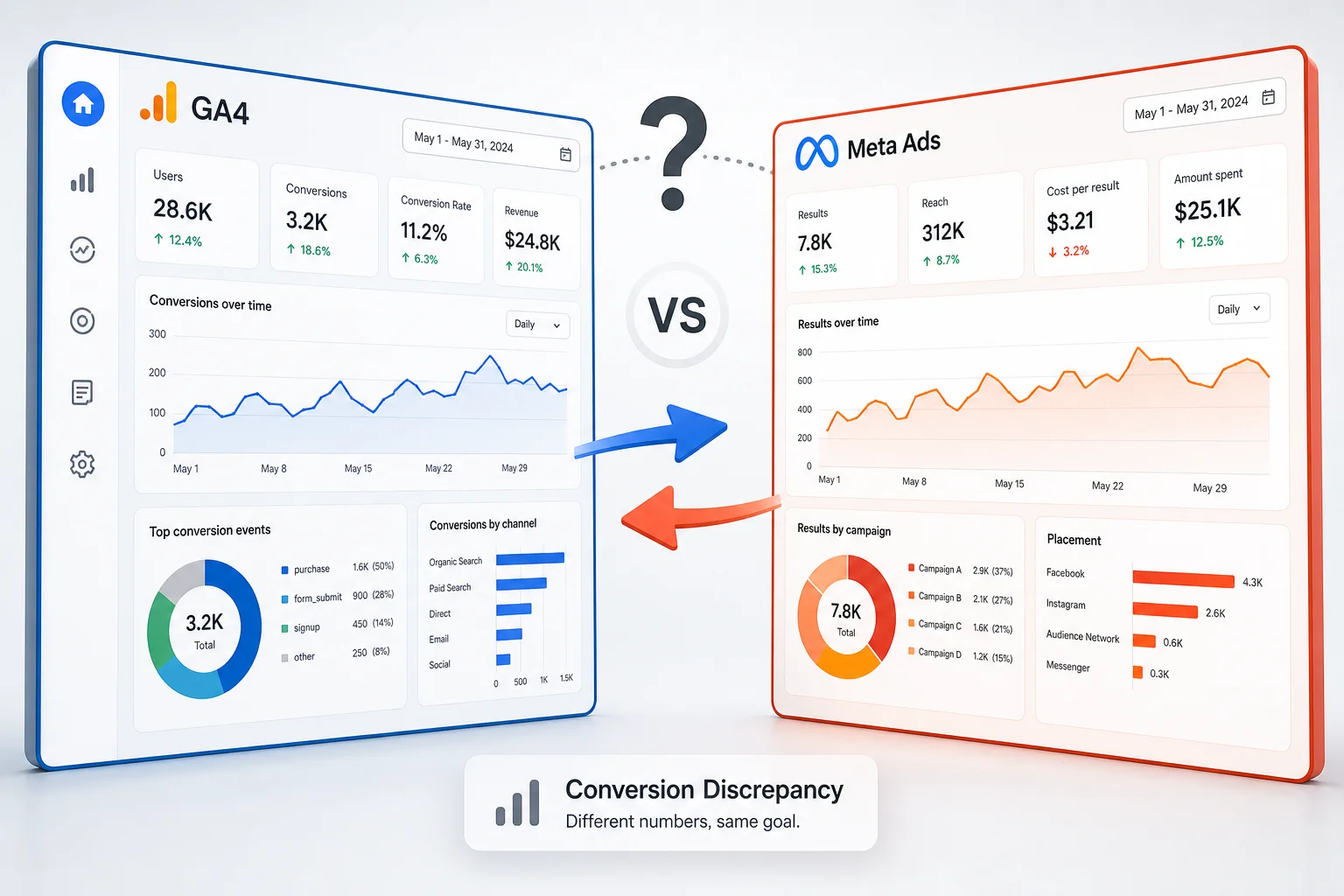
The ga4 vs meta ads conversion discrepancy is a common challenge faced by marketers today. Many businesses notice that Google Analytics 4 (GA4) reports fewer conversions than Meta Ads Manager. This discrepancy can lead to confusion and misinformed decisions about marketing strategies.
Key Takeaways
Understanding the differences in attribution models is crucial for accurate reporting.
Implementing best practices for conversion tracking can improve data reliability.
Addressing common challenges can help bridge the gap between platforms.
Digital illustration of GA4 and Meta Ads dashboards, showcasing contrasting styles and colors, highlighting conversion discre

Understanding GA4 vs
Meta Ads Conversion Discrepancy

The discrepancy in conversion numbers between GA4 and Meta Ads Manager can create confusion for marketers. Understanding the root causes behind this difference is essential for effective campaign management.

One primary factor is the attribution window, which defines how long after a user interacts with an ad a conversion will be counted. GA4 and Meta Ads Manager can use different attribution windows, and Meta typically allows users to customize these windows. These differing time frames can lead to varied reporting outcomes.

Additionally, the deduplication logic differs between the two platforms. The deduplication logic also differs between the platforms. On the Meta side, event_id is used to deduplicate browser Pixel and server Conversions API (CAPI) events: when both channels fire the same action with the same event_name and the same event_id, Meta treats them as one conversion. GA4, by contrast, uses an event-based measurement model, and its conversion counts can differ due to attribution windows and session scoping rather than shared event_id deduplication. In contrast, Meta’s deduplication process can be influenced by factors like view-through attribution, where conversions may be linked to ad impressions rather than just clicks.

Another important element is consent mode, which affects how data is collected and reported. If users do not consent to tracking, both platforms may record fewer conversions, but the impact can differ based on how each platform processes consented versus non-consented data.

For example, imagine a customer who views a Meta ad but does not click it. If they later convert within the attribution window, Meta may still attribute that conversion to the ad, while GA4 may not, depending on the event tracking setup.

Understanding these mechanisms is crucial for reconciling the ga4 vs meta ads conversion discrepancy and enhancing your tracking strategy. To dive deeper into your specific situation, consider our Conversion Tracking Audit service.

Core Concepts
of Attribution Models

Attribution models define how conversions are assigned to different marketing channels. GA4 uses multiple models, including data-driven attribution, which assigns value based on user interactions across touchpoints. In contrast, Meta Ads Manager often utilizes last-click attribution and view-through attribution, which may lead to different conversion counts. This variance can result in discrepancies when comparing GA4 data with Meta Ads reports.

The Role
of Attribution Windows

Digital illustration of two timelines for GA4 and Meta, showing ad clicks and conversions with arrows, devices, and data flow

Attribution windows refer to the time frame during which a conversion can be attributed to a specific action, such as an ad click or view. GA4 and Meta each apply their own attribution windows, which can differ in length. These differing time frames can significantly affect reported conversions, potentially leading to different conversion counts between the two platforms. These differing time frames can significantly affect reported conversions, leading to lower conversion counts in GA4 compared to Meta Ads.

Importance of Event Tracking

Event tracking is crucial in understanding user interactions. GA4 uses an event-based model, capturing a wide range of user activities through unique identifiers like event_id. This allows for detailed tracking of conversion events. Conversely, Meta Ads Manager may track fewer events depending on how conversion actions are defined. For instance, if GA4 captures multiple conversion events for a single interaction, Meta might consolidate these under one conversion. This deduplication logic can further explain the ga4 vs meta ads conversion discrepancy, as GA4 may report more granular data than Meta.

In summary, understanding these technical aspects helps clarify why conversions may differ across platforms. For a deeper analysis of your conversion tracking setup, consider our Conversion Tracking Audit service.

Benefits of
Accurate Conversion Tracking

Enhanced Marketing Efficiency

Accurate conversion tracking is crucial for optimizing marketing efforts. When platforms like GA4 and Meta Ads Manager report different conversion numbers, it can lead to confusion. This discrepancy often arises from differences in attribution models, which determine how conversions are credited to ads. For instance, GA4 may utilize data-driven attribution, considering multiple touchpoints, while Meta might employ a last-click model. As a result, discrepancies can mislead marketers regarding their campaign effectiveness, hindering decision-making.

Improved Budget Allocation

Understanding the nuances of conversion tracking helps in better budget allocation. If one platform shows more conversions, it may lead to overspending on less effective channels. Conversely, undervalued channels might miss out on necessary funding. For example, if GA4 attributes a conversion to organic search due to a longer attribution window, while Meta attributes it to a paid ad, a misallocation of budget could occur. By reconciling these differences, marketers can allocate resources more effectively to channels that truly drive conversions.

Better User Experience Insights

Discrepancies in reported conversions can also impact user experience insights. Both platforms track user interactions differently, influencing the understanding of customer behavior. GA4’s event tracking can capture detailed user actions, while Meta's view-through attribution focuses on ad impressions. This means conversion discrepancies can lead to a skewed perception of user engagement and intent. By aligning tracking methodologies, businesses can improve their understanding of customer journeys, ultimately enhancing user experience and satisfaction.

In light of these considerations, a thorough audit of conversion tracking practices is essential. By identifying and addressing discrepancies, companies can achieve clearer data alignment and actionable insights. For those looking to optimize their tracking setup, consider our Conversion Tracking Audit service to ensure accurate reporting and efficient marketing strategies.

Implementing GA4
Tracking for E-commerce

Setting Up Conversion Events

To effectively implement GA4 tracking for e-commerce, you must first define your conversion events. In GA4, conversion events are tracked as unique user interactions that are deemed valuable, such as completing a purchase or signing up for a newsletter. Set up these events in Google Tag Manager (GTM) using the correct event_id, which is a unique identifier for each event. Ensure that the parameters associated with these events align with your business objectives. For instance, you might track events like purchase, add_to_cart, or begin_checkout.

Integrating with Meta Ads Manager

Integrating GA4 with Meta Ads Manager can help you gain a holistic view of your conversion data. Utilize the Meta Pixel to track actions on your site that correspond to the conversion events set up in GA4. Ensure that the pixel is firing correctly and that the events being tracked in Meta align with those in GA4. This alignment is crucial for accurate reporting and understanding the ga4 vs meta ads conversion discrepancy. Pay attention to how each platform handles attribution windows and deduplication. For example, Meta may attribute conversions based on both clicks and view-through interactions, while GA4 uses a more nuanced approach depending on the attribution model selected.

Monitoring Performance and Adjustments

Regularly monitor the performance of your conversion tracking setup in both GA4 and Meta Ads Manager. Look for discrepancies in reported conversions, as these can highlight issues such as consent mode gaps or differences in deduplication logic. For instance, if a user clicks an ad but does not convert immediately, GA4 might not attribute that conversion unless it falls within the specified attribution window. Conversely, Meta may still count that interaction if it falls within its window. Regular audits can help identify such discrepancies, allowing you to make necessary adjustments. If you notice ongoing discrepancies, consider engaging in a Conversion Tracking Audit service to pinpoint and resolve the underlying issues effectively.

Best Practices for
Managing Conversion Discrepancies
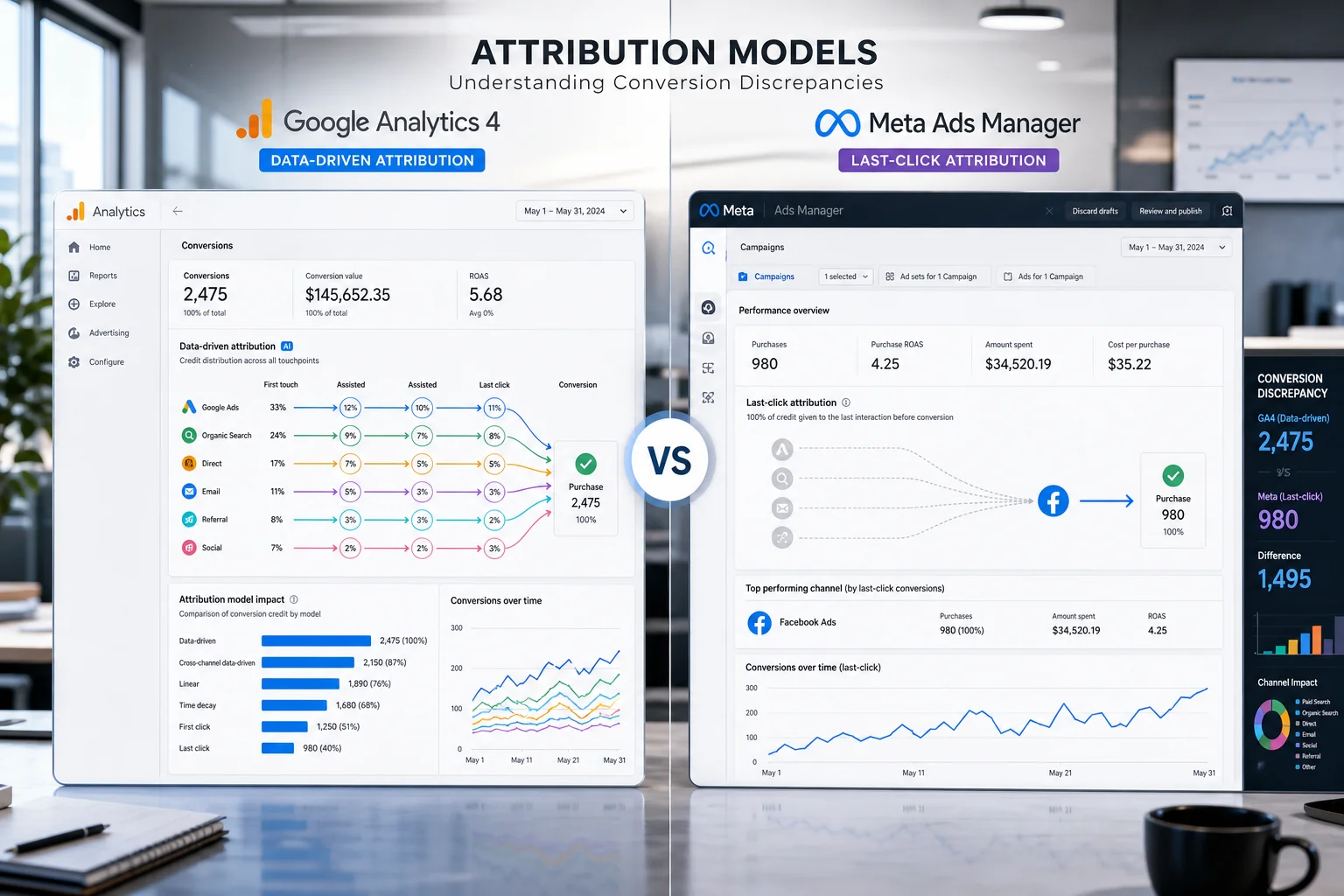
Digital illustration comparing GA4's multi-channel attribution with Meta Ads Manager's last-click model in a modern office se

Establishing Clear Attribution Models

To address the ga4 vs meta ads conversion discrepancy, it's crucial to understand how each platform attributes conversions. Google Analytics 4 (GA4) can utilize various attribution models, including data-driven attribution, which considers the contribution of multiple channels over time. In contrast, Meta Ads Manager often employs a last-click attribution model for direct conversions. Establishing a consistent attribution model across both platforms can help clarify how conversions are tracked and reported.

Regular Audits and Data Validation

Conducting regular audits of your data is essential for identifying discrepancies. This process should involve:

  • Cross-checking events: Ensure that the same conversion events are defined and tracked consistently in both GA4 and Meta.
  • Reviewing attribution windows: Verify that both platforms use similar attribution windows. For example, GA4’s default may be set to 30 days, while Meta might use a different duration. Differences here can lead to significant variation in reported conversions.
  • Assessing consent mode impacts: Understand how user consent affects tracking in GA4. For instance, if consent mode is enabled, it may limit the data GA4 collects, leading to fewer recorded conversions compared to Meta.

Utilizing Deduplication Techniques

Deduplication is vital when measuring conversions to avoid counting the same event multiple times. Each platform has its logic for deduplicating events:

  • Event_id: In Meta, the event_id is used to deduplicate the same action reported by the browser Pixel and the server-side Conversions API. The event_id must be unique per real-world action and identical on both the Pixel and CAPI payloads so Meta can count them as one conversion. Ensure your implementation sends a matching event_id and event_name on both channels.
  • Event parameters: In Meta, defining unique conversion events with specific parameters can help manage duplicates. Regularly review these definitions to maintain accuracy.

By implementing these best practices, marketing directors and analysts can better understand the reasons behind conversion discrepancies and improve their tracking accuracy. If you're facing ongoing challenges with conversion tracking, consider our Conversion Tracking Audit service to pinpoint and resolve issues effectively.

Addressing Common Challenges
in Conversion Tracking

Identifying Tracking Gaps

One common reason for discrepancies between GA4 and Meta Ads Manager is tracking gaps. These can arise from incorrect or incomplete event tracking setup. In GA4, an event_id is used to identify unique user interactions. If the same event is not consistently tracked across both platforms, it can lead to significant differences in reported conversions. For instance, if GA4 is set to track a purchase event but misses some due to configuration errors, it will report fewer conversions compared to Meta, which may capture those through its own tracking methods.

Handling User Consent and Privacy Issues

User consent plays a critical role in conversion tracking. With the rise of privacy regulations, both platforms have adjusted how they handle consent. GA4’s consent mode allows for tracking to be adjusted based on user preferences. If a user opts out, GA4 may not record their interaction, leading to lower conversion counts. Conversely, Meta may still attribute conversions based on modeled data or view-through attribution, potentially inflating their conversion metrics. Consequently, discrepancies can occur due to differences in how each platform respects user consent.

Dealing with Cross-Device Tracking

Cross-device tracking presents another challenge in understanding the ga4 vs meta ads conversion discrepancy. GA4 utilizes user identifiers to recognize the same user across devices, but if a user switches from mobile to desktop without being logged in, conversions may not be correctly attributed. In contrast, Meta uses its own methods to associate activity across devices, which can produce different attribution results than GA4. These variances can create further inconsistencies in conversion reporting. These variances can create further inconsistencies in conversion reporting.

Ultimately, recognizing and addressing these technical challenges can help clarify the discrepancies between GA4 and Meta Ads Manager. For businesses seeking to improve their conversion tracking accuracy, consider a thorough Conversion Tracking Audit to identify and rectify these issues.

Tools and Resources
for Effective Tracking

Modern workspace illustration featuring a large monitor with colorful analytics, GA4 DebugView, and productivity tools.

GA4 Configuration and Debugging Tools

To address the discrepancies between GA4 and Meta Ads Manager, proper configuration in GA4 is essential. Key tools include the GA4 DebugView, which allows users to monitor real-time data and verify event tracking setups. Additionally, utilizing the Google Tag Assistant can help ensure that the correct event_id is sent to GA4, confirming that conversions are accurately tracked. It's important to ensure that the attribution window in GA4 aligns with your business needs, as this window determines how long after an interaction a conversion can be attributed to that interaction.

Meta Ads Manager Features

Meta Ads Manager employs specific features that can contribute to conversion reporting differences. For instance, it utilizes view-through attribution, meaning that a conversion can be attributed to an ad view even if the user does not click the ad. This method can inflate conversion numbers compared to GA4, which may rely more heavily on click-through conversions. Additionally, Meta's deduplication logic ensures that a browser Pixel event and its matching server-side CAPI event for the same action are counted once, provided they share the same event_name and event_id. Missing or mismatched identifiers can prevent this deduplication and lead to inflated numbers.

Third-Party Analytics Solutions

For a more comprehensive view of conversion tracking, third-party analytics solutions can bridge the gap between GA4 and Meta Ads Manager. These tools can integrate data from both platforms, providing a unified view of conversion metrics. They often offer advanced tracking capabilities and can help identify issues related to consent mode gaps, which can affect how users are tracked across both platforms. Understanding these nuances is crucial for analysts looking to reconcile the ga4 vs meta ads conversion discrepancy.

By carefully configuring GA4, leveraging features from Meta Ads Manager, and considering third-party solutions, businesses can better understand and address conversion reporting discrepancies. For those needing help, MASS DATA d.o.o offers a Conversion Tracking Audit service to identify and resolve these issues effectively.

Hypothetical Example
of Discrepancy Resolution

Scenario Overview

Consider a mid-sized e-commerce company using both GA4 and Meta Ads Manager to track conversions from a recent marketing campaign. The marketing director observes a significant difference: GA4 reports noticeably fewer conversions than Meta Ads Manager for the same campaign. This discrepancy raises concerns about the accuracy of their data. This discrepancy raises concerns about the accuracy of their data.

Steps Taken to Analyze and Fix

To address this issue, the team initiated a thorough analysis, focusing on several technical aspects:

  1. Attribution Windows: They reviewed the attribution settings in both platforms. GA4 may have a shorter attribution window compared to Meta, which could explain why some conversions were not counted in GA4.
  2. Deduplication Logic: They examined how each platform handles deduplication. On the Meta side, a correctly shared event_id lets the Pixel and CAPI events for the same action be counted once; duplicates appear only when the event_id is missing or mismatched, or when the event_name differs. GA4's event-based counting and session scoping can produce different totals independently of Meta's deduplication.
  3. Consent Mode: Given recent privacy regulations, they assessed the impact of consent mode. If users opted out of tracking, GA4 may not report conversions for those visitors. This is particularly relevant in regions with strict privacy laws.
  4. Event Tracking: The team compared the defined conversion events in both platforms. They ensured that the same user actions were being tracked consistently.

Results and Insights Gained

After conducting their analysis, the team discovered that the differences primarily stemmed from the varying attribution windows and deduplication methods. They adjusted the attribution settings in GA4 to match Meta's timeframe more closely and refined their event definitions.

As a result of these adjustments, GA4's conversion count moved closer to Meta's total, narrowing the gap between the two platforms. This process highlighted the importance of understanding the underlying mechanics of tracking and attribution in both platforms. By aligning their methodologies, they gained clearer insights into the effectiveness of their campaigns.

For companies facing similar challenges, a Conversion Tracking Audit can help clarify discrepancies and optimize conversion tracking across platforms.

Conclusion

A diverse team of marketers collaborates around a digital screen filled with graphs, showcasing data analysis and attribution

In summary, the ga4 vs meta ads conversion discrepancy stems from differing attribution models, event tracking methods, and deduplication processes. Understanding these factors is essential for aligning your marketing data. By implementing best practices and utilizing appropriate tools, you can better manage these discrepancies and improve your conversion tracking.

To take the next step, consider a thorough audit of your conversion tracking setup. Start by reviewing your current attribution models and ensuring they align across platforms. This will provide clarity and enhance your decision-making processes.

Questions
Answered

Common questions related to this topic.

What is ga4 vs meta ads conversion discrepancy?

The ga4 vs meta ads conversion discrepancy refers to the difference in conversion numbers reported by Google Analytics 4 and Meta Ads Manager. These discrepancies arise due to varying attribution models and tracking methods employed by each platform.

How can I resolve the ga4 vs meta ads conversion discrepancy?

To resolve the ga4 vs meta ads conversion discrepancy, start by aligning the attribution models used in both platforms. Regularly audit conversion events and ensure that they are consistently defined across GA4 and Meta Ads to improve reporting accuracy.

Why do GA4 and Meta Ads show different conversion numbers?

GA4 and Meta Ads show different conversion numbers primarily because they operate on distinct attribution models and tracking methods. GA4 focuses on event-based tracking with stricter deduplication rules, while Meta Ads may include view-through conversions, leading to inflated numbers.

When should I investigate conversion discrepancies between GA4 and Meta Ads?

Investigate conversion discrepancies between GA4 and Meta Ads whenever you notice significant inconsistencies in reported numbers. Regular audits can help identify underlying issues and ensure accurate tracking across platforms.

Can I use both GA4 and Meta Ads for comprehensive tracking?

Yes, using both GA4 and Meta Ads can provide comprehensive tracking insights, but it's essential to understand their differences. Aligning tracking setups and interpreting data with these discrepancies in mind will enhance your overall marketing analysis.

Should I trust one platform over the other for conversion data?

It’s not about trusting one platform over the other; both provide valuable insights based on their methodologies. Understanding the unique aspects of each platform will help you interpret their data more accurately and make informed decisions. The ga4 vs meta ads conversion discrepancy is a common challenge faced by marketers. By understanding the differences in tracking and attribution methods, you can improve your conversion tracking strategy and make more informed decisions for your marketing efforts. Implementing best practices and leveraging the right tools will help bridge the gap

Free Strategy Call

Ready To GrowThis Into Results?

Discover the reasons behind the GA4 vs Meta Ads conversion discrepancy and how to address it effectively.

Opportunity Assessment
Channel Review
Growth Recommendations
No Obligation
OR

Prefer to reach out directly? We'll get back to you as soon as possible.

Contact MASS DATA Today
Scroll to Top