Mass Data - SEO & Data-Driven Digital Marketing

Google Ads AI Course: What Marketers Should Actually Learn

Learn what a Google Ads AI course should teach and how to use automation, Smart Bidding, Performance Max, and better conversion data effectively.
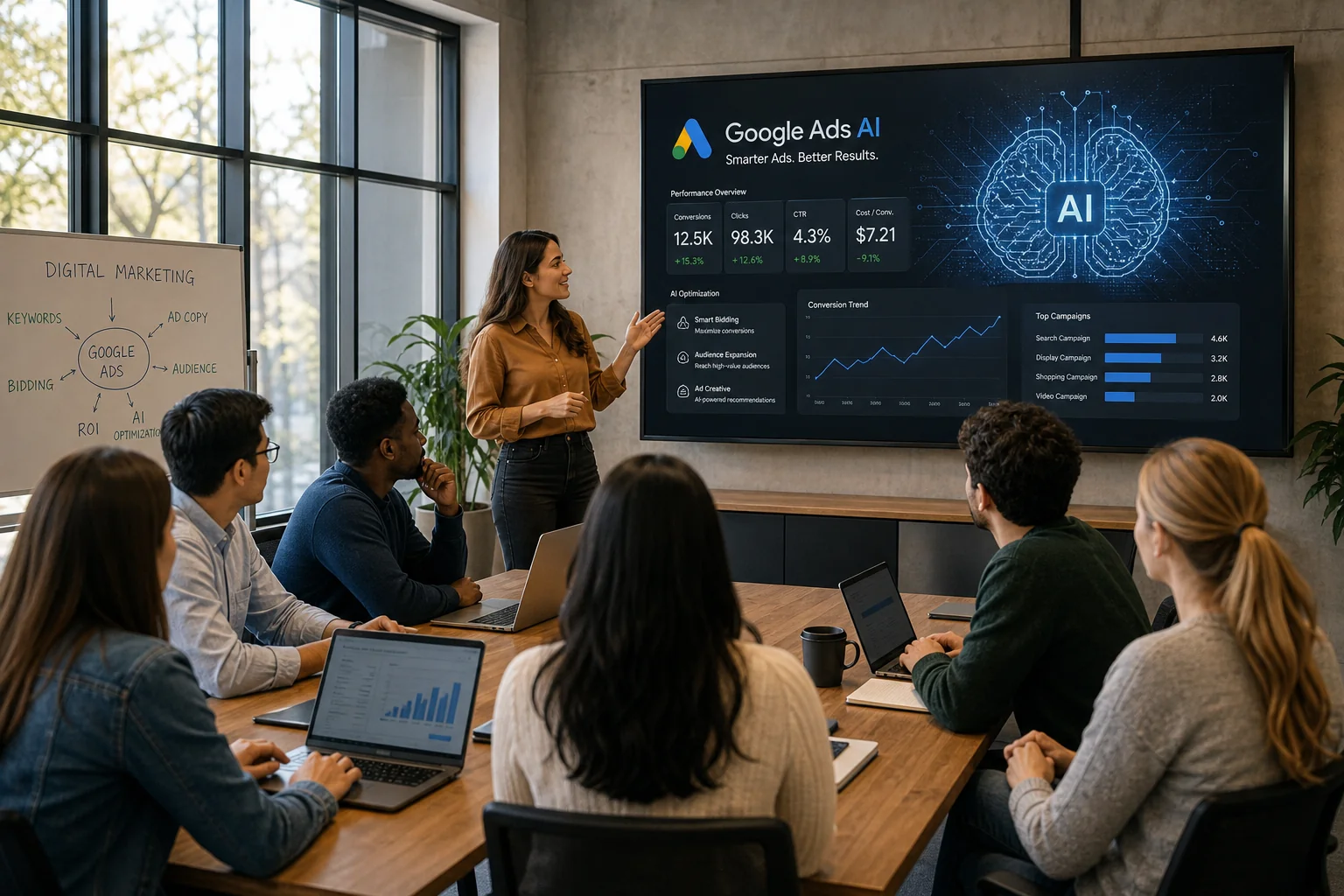
Diverse group engaged in digital marketing training, focused on Google Ads AI, with data visuals on screen and a collaborativ

Google Ads AI Course Skills That
Help You Manage Automation With More Control

A Google Ads AI course should do more than explain that artificial intelligence can automate bidding or build ads faster. Modern Google Ads already relies heavily on machine learning across bidding, targeting, creative combinations, campaign types, and measurement. The real skill is understanding what the system is optimizing, which inputs influence it, and when human intervention is still necessary.

For marketers, agencies, and business owners, that distinction matters. Automation can process far more auction signals than a person could manage manually, but it can also scale bad goals, weak conversion data, or poor campaign structure just as efficiently.

In this guide, you will learn:

  • Which Google Ads AI capabilities are worth understanding in practice
  • Why conversion data matters more as campaigns become more automated
  • Where human strategy still adds value
  • How to turn training into better campaign decisions rather than more automation for its own sake

What a Google Ads
AI Course Should Cover Today

The strongest training should connect platform knowledge with strategic judgment.

Google Ads now uses machine learning across features such as Smart Bidding, broad match, responsive creative, Performance Max, audience signals, and automated campaign optimization. Learning how to activate those features is useful, but marketers also need to understand what information the system receives and what outcome it has been asked to pursue.

For example, a Target ROAS bidding strategy may appear sophisticated, but it cannot compensate for incorrect purchase values. Performance Max can optimize across Google's inventory, but it still depends on appropriate goals, assets, audience information, and reliable measurement.

That is why training should begin with the mechanics of AI-driven advertising and then move quickly into decision-making.

Mass Data's guide to how AI analytics improve search performance explains how Smart Bidding, Performance Max, and broader matching can work together when automation is supported by relevant data.

Smart Bidding Is About
Signals, Not Giving Up Control

Automated bidding is one of the clearest examples of AI already embedded into Google Ads.

Instead of manually deciding a bid for every auction, Smart Bidding can evaluate contextual signals and adjust bids according to the advertiser's conversion objective. That allows decisions to happen at a scale and speed that manual management cannot realistically reproduce.

But choosing an automated strategy does not remove the marketer from the process.

Someone still needs to determine whether the campaign should optimize for conversions or conversion value, whether the target is realistic, whether budgets are sufficient, and whether the conversion actions being used represent meaningful outcomes.

A useful Google Ads AI course should therefore teach marketers how to diagnose poor results instead of simply switching bidding strategies whenever performance changes.

The deeper question is not "Is Smart Bidding working?" It is "What has the system been asked to optimize, and does the underlying data reflect commercial reality?"

For a broader explanation of how Google's machine learning can influence campaign performance, Mass Data's article on how Google AI helps marketers maximize Search Ads performance explores targeting, automation, and bidding in more detail.

Conversion Tracking Becomes More Important
as AI Takes Over More Decisions

The more campaign management is automated, the more important conversion quality becomes.

Google's algorithms learn from the outcomes advertisers feed back into the platform. If a campaign is told that every form submission is equally valuable, it will optimize toward forms. It cannot automatically know that one form becomes a €20,000 sale while another is an unqualified enquiry unless the measurement system communicates that difference.

The same issue exists in ecommerce.

If purchases are duplicated or revenue is passed incorrectly, an automated campaign may appear significantly more profitable than it really is. The algorithm then learns from misleading signals.

Mass Data's guide to Google Ads conversion tracking that drives growth explains why measurement should distinguish between activity and actual business value.

This is an important learning objective for anyone studying AI-driven Google Ads: better automation requires better inputs.

Performance Max Requires Strategy Even Though
Much of the Execution Is Automated

A focused digital marketing strategist analyzes data on multiple screens in a modern office, blending human insight with tech

Performance Max demonstrates why AI literacy is different from simply knowing where settings are located.

The campaign type uses Google's automation across multiple advertising environments and makes decisions around bidding, placements, audiences, and creative combinations based on the objectives and assets supplied.

That creates efficiency, but also changes the marketer's role.

Rather than adjusting every placement manually, marketers increasingly need to focus on inputs, campaign objectives, asset quality, audience signals, feed health, conversion data, and interpretation of reporting.

A practical training program should therefore teach marketers how to review automation critically.

Useful skills include:

  • Evaluating whether the campaign's conversion goals represent real value
  • Reviewing search and audience insights instead of treating Performance Max as a black box
  • Providing high-quality creative and feed inputs
  • Separating testing from permanent campaign structure
  • Understanding when another campaign type provides more useful control

The goal is not to fight automation. It is to know where automation is strong and where strategic constraints still matter.

Broad Match Works Differently
in an AI-Driven Search Environment

Keyword management has also changed.

Broad match increasingly relies on Google's ability to interpret search intent and combine query information with other available signals. This can uncover demand that tightly controlled keyword lists might miss.

That does not mean every account should switch all keywords to broad match.

The performance depends on campaign goals, conversion data, account structure, search demand, negatives, bidding, and the quality of the signals available to Google.

Training should therefore teach broad match as part of a wider system rather than as an isolated keyword setting.

Marketers still need to examine search terms, identify irrelevant traffic, understand which queries create business value, and protect areas where precision matters.

This is where human analysis remains important. Automation may identify patterns across millions of auctions, but the business still knows whether a particular search represents a useful customer.

Mass Data's article on how AI can transform a Google Ads strategy explores how machine learning can support targeting, bidding, ad creation, and budget decisions without eliminating the need for marketing judgment.

Human Judgment Is Becoming
More Strategic, Not Less Important

One of the biggest misconceptions about AI advertising is that better automation means less expertise is required.

In practice, the expertise shifts.

Manual bid adjustments may matter less than they did previously, but campaign economics, measurement architecture, customer intent, creative strategy, experimentation, and commercial interpretation become more important.

AI can tell the platform which auctions appear more likely to generate the selected outcome. It cannot independently decide whether your business should prioritize margin over revenue, whether a low-cost lead is commercially useful, or whether the offer itself needs improvement.

Strong Google Ads management increasingly requires marketers to understand:

campaign economics, attribution, conversion quality, audience intent, creative testing, search demand, and how automated systems react to changes.

This is also why practical experience matters alongside formal training.

Google itself offers free Google Ads learning paths through <a href="https://skillshop.withgoogle.com/googleads/">Skillshop</a>, which provides structured training across core areas of the platform. Skillshop

A course can explain the system. Managing real accounts teaches you how that system behaves when data is incomplete, budgets are constrained, seasonality changes, or business goals conflict.

A Hypothetical Example: When
More AI Produces Worse Results

A diverse team collaborates in a modern office, analyzing sales metrics on a screen, reflecting mixed emotions of excitement

Imagine a hypothetical ecommerce company selling premium home fitness equipment.

The team moves several campaigns to automated bidding and launches Performance Max. Revenue in Google Ads begins rising, and management initially concludes that automation has significantly improved performance.

A closer review reveals a measurement problem.

The purchase event sometimes fires twice after specific payment flows. Google Ads therefore receives inflated conversion values. Smart Bidding interprets some audience and traffic patterns as more profitable than they really are.

The company fixes the duplicate tracking and waits for enough clean data to accumulate.

Reported ROAS initially falls because the account is now measuring reality more accurately. The team then discovers which campaigns and products genuinely generate profitable sales.

This hypothetical example demonstrates why a Google Ads AI course should teach more than platform automation.

Without an understanding of measurement, the team could have interpreted bad data as successful AI optimization and increased spend accordingly.

For businesses that need campaign strategy, optimization, tracking, and reporting managed as one system, Mass Data's Google Ads management services combine paid search execution with measurement and performance analysis.

When a Course Is Useful and
When Hands-On Support Makes More Sense

Training is valuable when you want to understand the platform well enough to make better decisions internally.

A business owner may want enough knowledge to evaluate an agency. A junior media buyer may need structured foundations. An experienced marketer may need to update their knowledge as Google expands automation and introduces new campaign capabilities.

A course becomes less useful when the main problem is execution capacity.

If an agency already understands Google Ads but lacks time to manage additional accounts, more training will not solve the delivery bottleneck. The requirement is operational support.

Similarly, an advertiser with broken tracking does not primarily need another lesson on Smart Bidding. It needs the underlying measurement fixed.

The decision should reflect the gap you are trying to close: knowledge, implementation, strategy, or capacity.

Agencies that already have client relationships but need additional campaign delivery can use white-label Google Ads management to add Search, Shopping, Performance Max, YouTube, tracking, optimization, and reporting capacity without hiring another internal media buyer.

Conclusion

Diverse team collaborates in a modern office, analyzing data on a screen, showcasing teamwork and innovation in digital marke

A Google Ads AI course can be valuable, but not because AI removes the need to understand advertising.

The opposite is increasingly true.

As Google Ads automates more bidding, targeting, matching, and creative decisions, marketers need a stronger understanding of objectives, conversion quality, measurement, campaign economics, and the signals that guide machine learning.

Learning where AI performs well and where human judgment still matters is far more useful than memorizing every automated feature.

Start with official platform training, then apply the concepts to real campaign data. If the gap is execution rather than knowledge, work with specialists who can connect automation, tracking, optimization, and business outcomes into one measurable system.

Questions
Answered

Common questions related to this topic.

What is google ads ai course?

A Google Ads AI course is an educational program designed to teach marketers how to leverage artificial intelligence in their advertising strategies. It covers topics like automated bidding, audience targeting, and performance optimization. By mastering these techniques, businesses can improve ad effectiveness and enhance ROI.

How does AI improve Google Ads performance?

AI enhances Google Ads performance by analyzing vast amounts of data to identify trends and optimize campaigns in real-time. This means ads are shown to the right audience at the right time, leading to higher engagement and conversion rates. For instance, automated bidding strategies can adjust bids based on predicted performance.

Why is learning AI essential for marketers today?

Learning AI is crucial for marketers because it enables them to harness data-driven insights for better decision-making. With AI, marketers can automate repetitive tasks, personalize customer experiences, and optimize ad spend, resulting in more efficient campaigns and measurable growth.

When should I consider taking a google ads ai course?

Consider taking a Google Ads AI course when you're ready to enhance your digital marketing skills and stay competitive. If you’re launching new campaigns or looking to improve existing ones, this course can provide the necessary tools to harness AI effectively for your advertising strategies.

Can AI help small businesses with their Google Ads?

Yes, AI can significantly help small businesses optimize their Google Ads. By using AI tools, small businesses can automate bidding, segment audiences, and analyze performance more efficiently. This allows them to compete with larger companies by maximizing their limited budgets and increasing ad reach.

Should I prioritize AI training over other marketing skills?

Yes, prioritizing AI training can provide a competitive edge in today’s digital landscape. As AI continues to evolve, understanding its applications in marketing—including Google Ads—will be essential for driving growth and staying ahead of industry trends. Investing in this knowledge can lead to more effective campaigns and better results.

Free Strategy Call

Ready To GrowThis Into Results?

Learn what a Google Ads AI course should teach and how to use automation, Smart Bidding, Performance Max, and better conversion data effectively.

✓Opportunity Assessment
✓Channel Review
✓Growth Recommendations
✓No Obligation
OR

Prefer to reach out directly? We'll get back to you as soon as possible.

Contact MASS DATA Today
Scroll to Top