HubSpot vs Klaviyo: Tools for AI-Driven Lead Nurturing
Explore HubSpot vs Klaviyo for AI-driven lead nurturing. Understand their strengths and limitations for effective marketing.
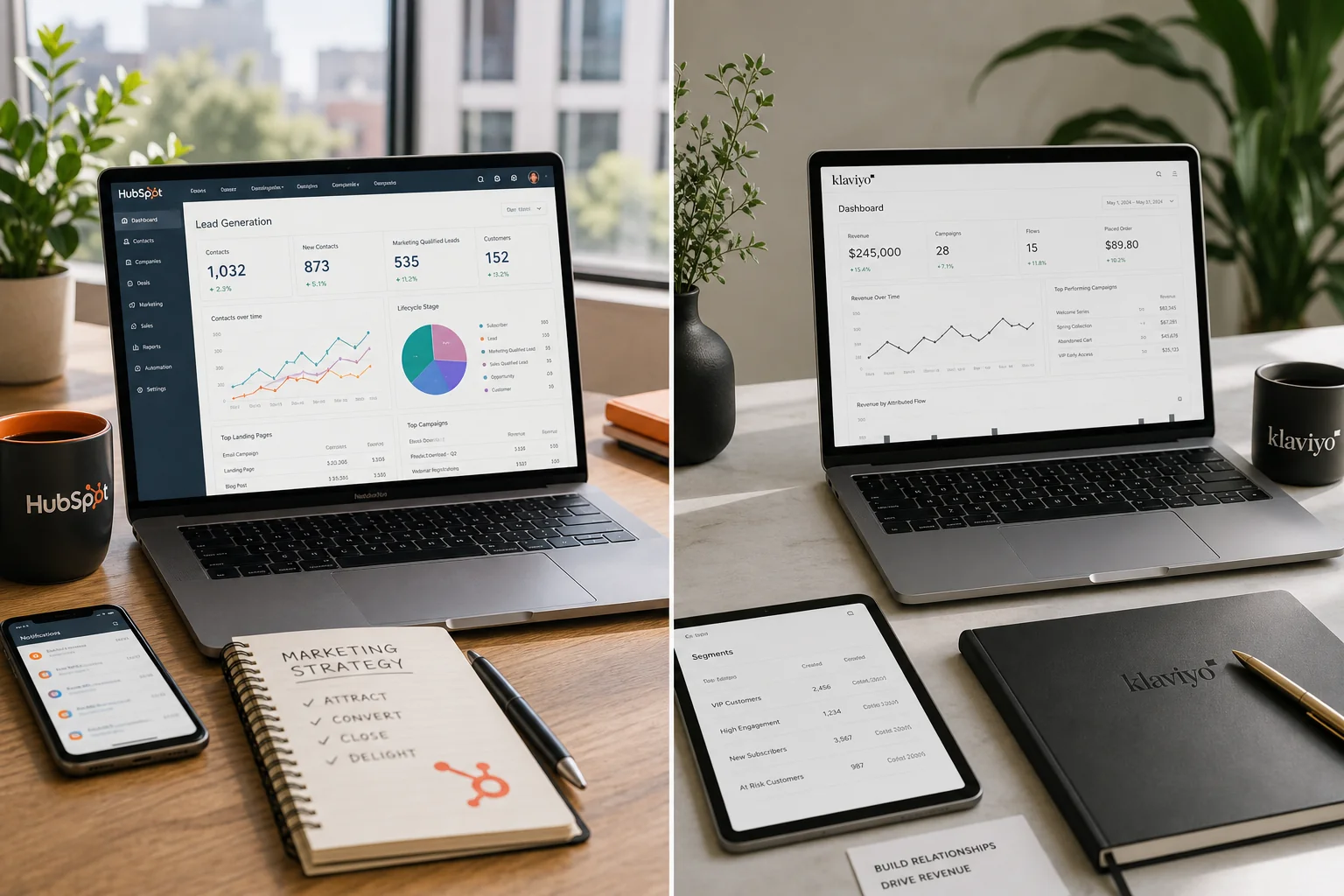
HubSpot vs Klaviyo AI Lead Nurturing
for More Relevant, Automated Customer Journeys
Choosing between HubSpot vs Klaviyo AI lead nurturing is not simply a question of which platform has more automation features. The better choice depends on the type of customer journey you manage, the data available to your marketing team, and whether your business is primarily sales-led, ecommerce-led, or somewhere in between.
HubSpot is built around a broader CRM and marketing ecosystem, while Klaviyo has traditionally been especially strong in behavior-driven ecommerce messaging. Both can automate communication, segment audiences, and use customer data to make nurturing more relevant.
In this guide, you will learn:
- Where HubSpot and Klaviyo differ most in lead nurturing
- Which platform better suits B2B, ecommerce, and hybrid businesses
- How AI can improve segmentation and workflow decisions
- What to evaluate before migrating or rebuilding your automation stack
The Real Difference
Between HubSpot and Klaviyo
The most useful way to compare the platforms is to start with their center of gravity.
HubSpot is designed around the CRM. Marketing activity can sit alongside sales records, deals, contact history, forms, service interactions, and other customer information. That makes it particularly relevant when lead nurturing needs to support a longer sales process and eventually hand qualified prospects to a sales team.
Klaviyo is more strongly associated with ecommerce lifecycle marketing. Its automation model is particularly useful when purchase history, product browsing, cart activity, customer value, and other commerce behaviors determine what message should come next.
This distinction matters more than comparing feature checklists.
A B2B company selling a complex service with a six-month buying cycle has very different nurturing requirements from an online retailer trying to move a first-time buyer toward a second purchase.
Before choosing either platform, map the journey you are trying to automate. Mass Data's guide to a practical automated marketing system shows how traffic, lead capture, CRM data, segmentation, nurturing, and sales handoff can fit into one connected process.
HubSpot vs Klaviyo AI Lead
Nurturing for B2B and Ecommerce
For B2B businesses, HubSpot's broader CRM context can be a major advantage.
A prospect may download content, visit pricing pages, submit a form, attend a webinar, interact with sales, and move through several deal stages before buying. Nurturing therefore needs to reflect much more than email engagement.
The CRM relationship allows teams to build workflows around lifecycle stage, contact properties, sales activity, lead status, and other customer information.
HubSpot has also expanded AI capabilities within its workflow tools, which can assist marketers in handling and interpreting data on enrolled records.
Klaviyo is often a more natural fit when customer behavior revolves around products and transactions.
An ecommerce brand may need abandoned-cart flows, post-purchase sequences, replenishment reminders, win-back campaigns, VIP segments, and product recommendations based on what someone has already purchased or viewed.
The question is therefore less "Which platform is better?" and more "Which data model most closely resembles our actual customer journey?"
Email Automation:
Workflows vs Flows
Both platforms allow marketers to automate journeys based on customer behavior, but the terminology and surrounding ecosystem differ.
HubSpot uses workflows. These can automate marketing communication while also updating CRM records, creating tasks, changing lifecycle stages, triggering internal notifications, and supporting sales processes.
That makes workflows useful when nurturing extends beyond the marketing inbox.
Imagine a prospect who visits a high-value service page several times, downloads a technical guide, and then submits a consultation form. The workflow might adjust the contact's status, notify a salesperson, enroll the lead into relevant nurturing, and stop marketing communication once a sales conversation begins.
Klaviyo uses flows.
Flows are strongly suited to lifecycle messaging triggered by customer and ecommerce activity. A customer who abandons a cart, purchases a particular product, reaches a customer-value threshold, or becomes inactive can enter a tailored communication sequence.
For ecommerce teams, that closeness to customer behavior can make sophisticated personalization easier to operationalize.
Neither structure is inherently superior. The right automation model is the one that reflects the decisions your business actually needs to make.
For a broader view of how automation systems should be evaluated before adding more complexity, Mass Data's marketing automation audit guide covers data quality, workflow structure, integrations, and performance.
Where AI Actually Adds
Value to Lead Nurturing

AI can improve nurturing, but its value is often overstated.
The useful applications are not simply generating more email copy. AI becomes more interesting when it helps marketers interpret data, identify meaningful customer groups, prioritize opportunities, or make complex workflows easier to manage.
In a practical nurturing system, AI can support:
- Audience and customer segmentation based on multiple behavioral signals
- Prioritization of higher-intent or higher-value contacts
- Content variation based on known customer context
- Analysis of CRM or ecommerce data before workflow branching
- Faster identification of patterns that marketers can test and refine
Human judgment still matters.
A platform may identify that a prospect has a high likelihood of converting, but your team still needs to decide whether that prediction deserves a sales call, a case study, a product recommendation, or no additional contact at all.
The same principle applies to AI-generated communication. Personalization should make the message more useful, not simply insert more customer data into an automated email.
Mass Data's article on B2B marketing automation strategy and lead nurturing explores how scoring, behavioral triggers, and sales handoffs can support longer buying journeys.
Segmentation Is Where the
Platforms Become More Distinct
Strong nurturing depends on knowing who should receive the message.
HubSpot segmentation can be especially valuable when marketing and sales information needs to be evaluated together. A team might distinguish leads according to industry, company size, lifecycle stage, content engagement, sales activity, or another CRM property.
Klaviyo's segmentation becomes particularly powerful when purchasing behavior is central.
An ecommerce brand can think in terms of first-time buyers, frequent purchasers, customers interested in a product category, high-value customers, inactive shoppers, or audiences reaching a likely repurchase window.
That can make Klaviyo attractive for ecommerce retention because the messaging can respond directly to commercial behavior.
But complexity should not become the objective.
A business with 150 micro-segments may have technically sophisticated automation and still deliver a fragmented customer experience. Build segments only when the difference changes the message, timing, channel, or next action.
This is also why automation strategy should precede platform configuration. Mass Data's article on marketing automation services and lifecycle systems explains how customer journeys, behavioral triggers, CRM data, and cross-channel communication can work as one system rather than independent automations.
Data Quality Matters More
Than the AI Feature List
The quality of HubSpot vs Klaviyo AI lead nurturing ultimately depends on the information feeding the automation.
AI cannot compensate for duplicate contacts, missing purchase events, inconsistent lifecycle stages, incorrect tracking, or CRM fields that nobody maintains.
Poor data creates poor segmentation.
Suppose an ecommerce store sends a win-back flow to customers classified as inactive, but its order integration failed for several days. Some recent customers could incorrectly receive an incentive to return immediately after purchasing.
A B2B example might be even more damaging. If CRM lifecycle stages are unreliable, an automated nurture flow could continue sending introductory content to a prospect already negotiating with sales.
Before introducing predictive models or complex AI logic, verify the underlying data flow.
Check what enters the platform, which system owns each field, how events are synchronized, when profiles are updated, and what happens when data is missing.
If those foundations are weak, adding more automation usually scales the problem rather than solving it.
A Hypothetical HubSpot
vs Klaviyo Scenario

Consider a hypothetical company that sells specialist equipment online while also generating larger B2B inquiries from corporate buyers.
Its ecommerce team wants behavior-based product flows, post-purchase communication, and win-back campaigns. The sales team needs CRM records, lead qualification, follow-up tasks, and visibility into longer B2B opportunities.
Trying to force both customer journeys into one identical automation structure could create unnecessary compromises.
The company might decide to use Klaviyo for ecommerce lifecycle communication while HubSpot manages B2B leads and sales processes. Reliable integration between the two systems then becomes essential so contacts do not receive contradictory communication.
Alternatively, if ecommerce represents only a small part of the business, consolidating more activity inside HubSpot may reduce operational complexity.
If ecommerce becomes the dominant revenue stream, deeper Klaviyo workflows may provide more value.
The important point is that HubSpot vs Klaviyo AI lead nurturing does not always require an absolute winner.
Platform architecture should follow the customer journey.
Integration Can Matter
More Than Platform Choice
Marketing stacks rarely contain only one platform.
A business may have Shopify or WooCommerce, a CRM, GA4, advertising platforms, customer support software, lead forms, payment systems, and business intelligence tools alongside HubSpot or Klaviyo.
The nurturing platform needs the right information from those systems at the right time.
If a form submission reaches HubSpot but purchase data lives only in the ecommerce platform, segmentation will remain incomplete. If Klaviyo receives purchase data but no meaningful B2B sales information, it cannot account for an active sales conversation.
This is where automation projects often become integration projects.
Mass Data's AI marketing automation and integration services connect platforms such as HubSpot, Klaviyo, Salesforce, analytics tools, automation platforms, and custom APIs into wider marketing systems.
The strongest stack is not necessarily the one with the most applications. It is the one where customer information can move reliably between the systems that need it.
Choosing HubSpot or Klaviyo
Based on Business Model
The decision becomes easier when you start with operational requirements instead of software features.
HubSpot is likely to deserve stronger consideration when CRM management, B2B lead nurturing, sales handoff, pipeline visibility, forms, and longer sales cycles are central to the business.
Klaviyo becomes particularly attractive when ecommerce transactions, product behavior, lifecycle messaging, repeat purchases, and retention are the primary focus.
Some businesses will legitimately need both.
But using both creates additional responsibilities around data synchronization, consent, contact ownership, attribution, and automation conflicts.
The wrong decision is usually not choosing HubSpot instead of Klaviyo or vice versa. The wrong decision is implementing sophisticated automation without understanding how customer data should move through the business.
For companies that need the full system mapped before implementation, Mass Data's marketing automation services cover CRM, email, analytics, workflow design, integrations, testing, and ongoing optimization.
Conclusion
The right answer to HubSpot vs Klaviyo AI lead nurturing depends less on which platform has the longest feature list and more on how your business acquires, nurtures, converts, and retains customers.
HubSpot has clear advantages when CRM context, B2B sales processes, and marketing-to-sales handoff are central. Klaviyo is particularly compelling when ecommerce behavior, lifecycle communication, segmentation, and repeat purchasing drive the customer journey.
AI can make both systems smarter, but the fundamentals remain the same: reliable data, meaningful segmentation, relevant communication, and workflows built around real customer behavior.
Choose the platform that matches your operating model first. Then use AI and automation to improve that system rather than allowing the technology to define the strategy.
Questions
Answered
Common questions related to this topic.
What is hubspot vs klaviyo ai lead nurturing?
HubSpot and Klaviyo both offer AI-driven lead nurturing solutions that automate and personalize communication with potential customers. HubSpot focuses on a broader marketing automation approach, while Klaviyo excels in e-commerce email marketing. Understanding these differences can help you choose the right platform for your business needs.
How does hubspot vs klaviyo ai lead nurturing work?
Both platforms utilize AI to analyze lead behavior and preferences, allowing for targeted messaging. HubSpot uses workflows to automate processes based on specific triggers, while Klaviyo employs flows that respond to user actions. This ensures that leads receive relevant content that encourages engagement and conversion.
Why should I consider AI for lead nurturing?
AI can significantly enhance lead nurturing by personalizing communication and optimizing engagement strategies. By leveraging data-driven insights, businesses can send timely, relevant messages to leads, improving the likelihood of conversion. This approach helps in maintaining a competitive edge in today's digital marketing landscape.
When is the best time to implement AI lead nurturing?
The best time to implement AI lead nurturing is when your lead volume increases or when you notice gaps in engagement. Integrating AI tools like HubSpot or Klaviyo can help automate responses and improve the overall efficiency of your lead nurturing process, particularly during peak marketing campaigns.
Can HubSpot and Klaviyo integrate with other tools for better lead nurturing?
Yes, both HubSpot and Klaviyo offer robust integration capabilities with various third-party tools. For instance, they can connect with CRM systems, e-commerce platforms, and automation tools like Zapier. These integrations enhance the functionality of your lead nurturing efforts, allowing for comprehensive data management and outreach.
Should I prioritize one platform over the other for my business?
Choosing between HubSpot and Klaviyo depends on your specific business needs. If your focus is on comprehensive marketing automation and CRM integration, HubSpot may be the better choice. Conversely, if your main goal is email marketing for e-commerce, Klaviyo could provide the specialized features you require for successful lead nurturing.
Ready To GrowThis Into Results?
Explore HubSpot vs Klaviyo for AI-driven lead nurturing. Understand their strengths and limitations for effective marketing.
Prefer to reach out directly? We'll get back to you as soon as possible.
Contact MASS DATA Today