MASS DATA — AI Search Optimization (GEO)

Do You Need an llms.txt File? Understanding Its Importance

Discover if you need an llms.txt file and how it impacts AI search visibility.

A modern office workspace with a laptop showing code, documents, and a potted plant, illuminated by natural light.

Do You Need an llms.txt
File for Better AI Search Visibility?

As AI search becomes more important, website owners are being told to add new technical elements to stay visible. One of the most discussed is llms.txt. But do you need an llms.txt file to improve visibility in ChatGPT, Gemini, Perplexity, or other AI-driven environments?

The answer is more nuanced than many SEO checklists suggest. llms.txt is a legitimate emerging proposal designed to make website content easier for AI agents to discover and interpret, but it is not a universal ranking factor and it does not replace SEO fundamentals.

In this guide, you will learn:

  • What llms.txt actually is
  • When it can be useful
  • What it cannot do for rankings or AI visibility
  • How it differs from robots.txt, sitemaps, and schema
  • Whether implementing it deserves priority on your website

What Is
an llms.txt File?

An llms.txt file is a proposed Markdown-based resource that gives AI agents a concise overview of a website and points them toward useful pages or documentation.

The official llms.txt proposal describes it as a way to provide LLM-friendly content and links in a format that is easier for agents to process than a complex web page. The idea has been proposed as a way for documentation platforms and AI-related developer resources to present content in an agent-friendly format. llms-txt

The important point is that llms.txt is not primarily a crawling control file.

It is closer to a curated guide.

A website can use it to explain what the site is about, identify important resources, and direct AI agents toward useful documentation, articles, product information, or other relevant pages.

That makes it fundamentally different from robots.txt, which is used for crawler directives, and from XML sitemaps, which help search engines discover URLs.

If you are already exploring AI search optimization and how brands become more visible in ChatGPT, Gemini, and Perplexity, it is better to treat llms.txt as one supporting layer rather than as the core strategy.

What Google
Says About llms.txt

An important clarification on this topic has come from Google.

Google Search Central clarified in June 2026 that llms.txt files are not needed for Google Search and do not positively or negatively affect visibility or rankings. Google also noted that websites are free to maintain them for other services or systems that choose to use them. Google for Developers

That clarification matters because a lot of early discussion around llms.txt treated it as if it might become a direct SEO requirement.

At the moment, that is not the case.

Google's generative search features continue to rely on broader search infrastructure and established SEO fundamentals such as crawlability, indexability, useful content, and internal linking.

So if your main reason for asking do you need an llms.txt file is to improve Google rankings, the answer is no.

If your goal is to make important content easier for other AI agents to navigate and interpret, the file may still be worth considering.

Do You Need an llms.txt
File for AI Search Optimization?

For most websites, llms.txt should be treated as optional rather than essential.

The strongest case exists when a site contains a large amount of structured or technical information.

Documentation-heavy SaaS companies are a good example. An AI agent may need to understand installation instructions, API references, authentication methods, pricing documentation, integrations, troubleshooting guides, and product limitations. A curated llms.txt file can point the agent toward the most relevant resources without requiring it to navigate a large and complex site from scratch.

The same logic can apply to research portals, technical B2B businesses, documentation libraries, or websites with large knowledge bases.

For a small local business with a few straightforward service pages, the value is less obvious.

The practical question is not whether llms.txt is fashionable. It is whether the file provides useful structure that does not already exist elsewhere.

Mass Data's GEO case study on AI visibility shows why AI visibility should be evaluated as a combination of content, technical implementation, entity consistency, and discoverability rather than one isolated tactic.

llms.txt vs. robots.txt,
Sitemaps, and Schema
A serene modern workspace with a sleek monitor displaying digital file icons, complemented by a laptop and coffee, in soft li

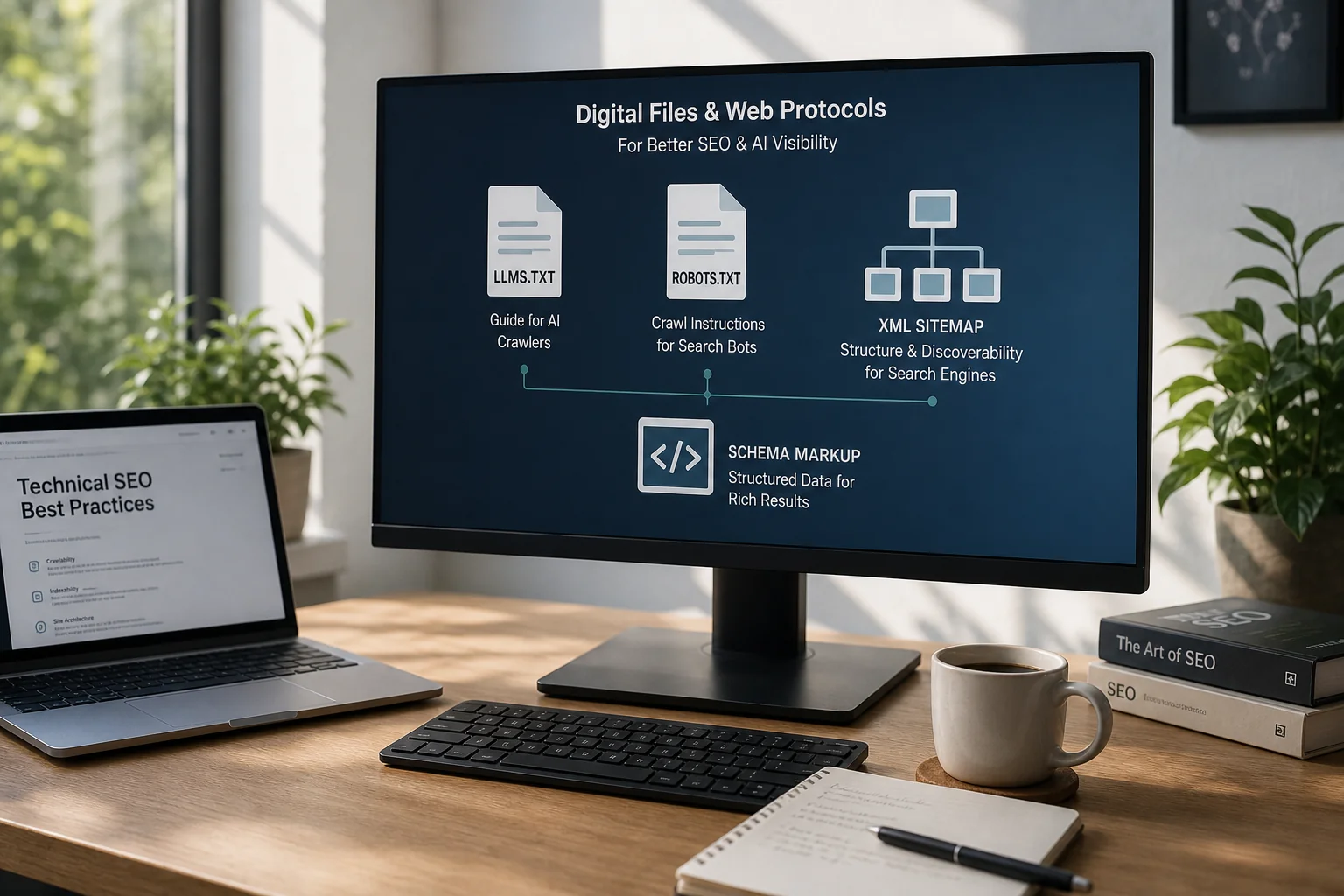
These technologies are often grouped together, but they solve different problems.

robots.txt communicates crawler access preferences.

An XML sitemap gives search engines a list of URLs they may want to discover or crawl.

Schema markup provides structured information about entities, pages, products, organizations, events, and other content types.

An llms.txt file is intended to provide AI agents with a curated, machine-readable overview of important information.

That means one should not replace another.

A website with poor crawlability, broken internal linking, duplicate content, unclear canonicalization, or thin pages will not become AI-friendly simply because an llms.txt file has been added.

The broader foundation still matters more.

This is also why content marketing for AI and organic search remains relevant. AI systems need useful information to retrieve in the first place, and no technical file can compensate for weak content.

When an llms.txt
File Is Worth Implementing

There are situations where the implementation cost is low and the potential usefulness is reasonable.

A business with extensive developer documentation could use llms.txt to highlight the most important sections.

A large ecommerce platform might use it to direct agents toward product documentation, returns policies, shipping information, sizing guides, or other stable resources.

A B2B company with a large resource library could point agents toward authoritative service descriptions, research, documentation, and technical materials.

Before implementing it, evaluate whether:

  • Your site contains enough complexity to benefit from an additional navigation layer
  • Important resources are stable and worth highlighting
  • Your team can keep the file updated
  • Your wider SEO and content foundations are already in good shape
  • You understand that implementation does not guarantee citations or rankings

The file makes most sense when it improves information access, not when it is added simply to satisfy an AI SEO checklist.

How to Structure
an llms.txt File

Although llms.txt and robots.txt are both machine-readable files, they serve very different purposes and should not be used interchangeably.

The proposed format is based on Markdown, not crawler directives such as User-agent, Allow, and Disallow.

A useful llms.txt file can begin with the name of the site or project, followed by a concise description. It can then organize important resources under clear headings with links and short explanations.

For example, a SaaS business could include sections for documentation, integrations, pricing, API references, security, and support.

The goal should not be to duplicate the entire website.

Instead, the file should help an AI agent quickly locate the content that is most relevant to understanding the site or answering likely questions.

Keeping it concise also makes maintenance easier.

If the website changes significantly, update the file so it does not contain obsolete or redirected URLs.

Common Misconceptions About llms.txt

The first misconception is that llms.txt automatically improves rankings.

It does not.

The second is that every AI crawler will use the file. There is no universal requirement forcing AI systems to read or follow it.

Another common mistake is assuming that adding llms.txt will cause ChatGPT or another AI system to cite a site more frequently.

Citation decisions depend on many factors, including query relevance, available sources, retrieval systems, content quality, and platform-specific behavior.

A fourth misconception is that llms.txt can compensate for weak SEO.

It cannot.

Businesses should still prioritize crawlability, useful content, clear site structure, internal links, structured data where relevant, and accurate entity information.

This is also where brand monitoring across ChatGPT, Perplexity, and Gemini becomes useful. Instead of assuming that an implementation worked, marketers can observe whether their visibility actually changes across relevant AI queries.

A Hypothetical
llms.txt Use Case

A sleek office workspace with a large monitor displaying analytics, open books, and natural light, exuding innovation and eff

Consider a hypothetical analytics platform with several hundred documentation pages.

Its site contains product documentation, API references, integrations, setup guides, troubleshooting content, release notes, and security information.

A user asks an AI assistant whether the platform can connect offline CRM conversions with an advertising platform.

The relevant answer may depend on several pages covering integration requirements, authentication, supported data fields, and limitations.

An llms.txt file could give an AI agent a clearer path to those resources.

Would that guarantee that the platform appears in the answer? No.

Would it eliminate the need for clear, crawlable documentation? Also no.

But in this situation, adding a curated agent-oriented resource is reasonable because the website is large, structured, and documentation-heavy.

For a five-page local service website, the same effort is unlikely to have the same value.

Where llms.txt Fits in
Your AI Search Priorities

If you are deciding do you need an llms.txt file before investing in other work, start with the basics.

Make sure important pages are crawlable and indexable.

Check whether your content genuinely answers the questions customers ask.

Strengthen internal linking between related topics.

Keep brand, service, and product information consistent.

Review structured data where it adds real meaning.

Improve weak or outdated content.

Only then evaluate whether llms.txt adds a useful extra layer.

This order matters because AI visibility is usually a system-level outcome.

Mass Data's growth marketing services connect search, analytics, content, tracking, and conversion work into a broader growth framework rather than treating each tactic in isolation.

For agencies that want to expand SEO and AI-search capabilities without building every resource internally, Mass Data's white-label agency services can also support delivery across SEO, content, analytics, and technical marketing work.

Conclusion

A professional analyzes complex data on multiple screens in a serene, well-lit office, surrounded by notepads and art.

The answer to do you need an llms.txt file is not a simple yes or no.

It is a legitimate and increasingly adopted proposal that can make complex website information easier for AI agents to navigate. It is not, however, a direct ranking factor, a replacement for traditional SEO, or a guaranteed route into AI-generated answers.

For documentation-heavy websites, SaaS platforms, large knowledge bases, and businesses actively preparing for AI-assisted discovery, implementing llms.txt can be a sensible low-cost addition.

For most businesses, the priority should still be clear content, technical accessibility, strong internal linking, accurate structured information, and a website that genuinely helps users solve problems.

Questions
Answered

Common questions related to this topic.

What is an llms.txt file?

An llms.txt file is a text document that helps AI crawlers understand the structure and content of a website. It provides guidance on how to index the site effectively, enhancing visibility in AI-driven search engines. For example, it can specify which sections of the site are most important for indexing.

Do you need an llms.txt file for your website?

Not every website requires an llms.txt file, but it can be beneficial for those looking to optimize for AI search engines. If your site is content-heavy or aims to improve its search visibility, implementing this file may enhance how crawlers perceive your content.

How does an llms.txt file improve website visibility?

An llms.txt file improves visibility by providing AI crawlers with clear instructions on how to navigate and index your site. This can lead to better understanding and categorization of your content. Consequently, it may help improve the chances of appearing in relevant search results.

When should I implement an llms.txt file?

You should consider implementing an llms.txt file when launching a new website or significantly updating your existing site. It’s particularly useful if your business plans to leverage AI-driven search technologies to attract more users and enhance visibility.

Can an llms.txt file guarantee higher search rankings?

No, an llms.txt file does not guarantee higher search rankings. It simply informs crawlers about your website's structure and content. While it can improve how your site is indexed, actual ranking depends on various factors, including the quality of your content and overall SEO strategies.

What are common challenges when creating an llms.txt file?

Common challenges include understanding the technical requirements and ensuring the file is correctly formatted. Many users may find it daunting, but with proper guidance, creating an llms.txt file can be straightforward, allowing you to effectively communicate with AI crawlers.

Free Strategy Call

Ready To GrowThis Into Results?

Discover if you need an llms.txt file and how it impacts AI search visibility.

✓Opportunity Assessment
✓Channel Review
✓Growth Recommendations
✓No Obligation
OR

Prefer to reach out directly? We'll get back to you as soon as possible.

Contact MASS DATA Today
Scroll to Top