Google AI Mode vs AI Overviews: What Changes for Your Traffic
Understand the differences between Google AI Mode and AI Overviews and what they mean for organic traffic. Explore how AI-generated search results affect clicks, content visibility, SEO strategy, and website performance, including practical ways to measure and respond to changing search behavior.
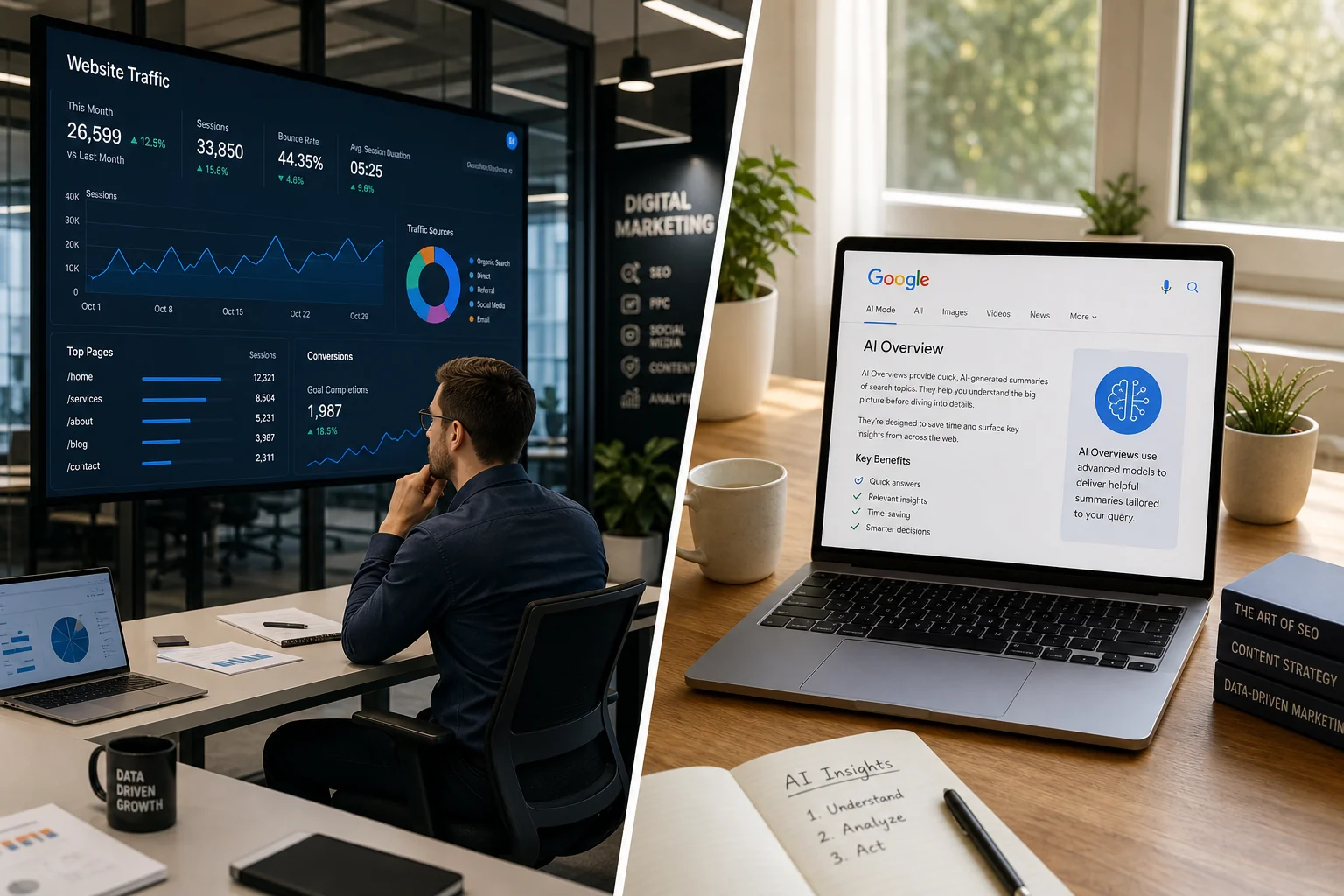
Google AI Mode vs AI Overviews: Understanding
the Impact on SEO and Organic Traffic
Google Search is changing how people discover information, evaluate businesses, and decide which websites deserve a visit. Instead of navigating through traditional search results alone, users can now receive AI-generated summaries, explore complex questions conversationally, and follow links to supporting sources.
For website owners and marketing teams, this creates a significant challenge. A page may remain visible in Google Search while receiving fewer clicks, particularly when an AI-generated answer satisfies the user's immediate information need. At the same time, AI-powered search can introduce brands to potential customers who might not have discovered them through conventional rankings.
Understanding Google AI Mode vs AI Overviews is essential because these features serve different purposes, display information differently, and can influence organic traffic in different ways. Although both use generative AI, they should not be treated as identical search experiences or measured exclusively through traditional keyword rankings.
This guide explains:
-
How AI Mode and AI Overviews work and where they appear in Google Search.
-
Why AI-generated answers can influence organic traffic and click-through rates.
-
Which SEO strategies remain relevant for visibility in AI-powered search.
-
How to measure AI search visibility alongside website engagement and conversions.
-
What businesses should prioritize before changing their content strategies.
The objective is not to abandon traditional SEO. It is to understand how search behavior is evolving and develop content that remains valuable whether customers encounter it through conventional results, AI summaries, or conversational search.
Understanding the Differences Between
AI Mode and AI Overviews
Google AI Overviews are AI-generated summaries that appear within the conventional Google Search results experience when Google's systems determine that a summary would be useful. They can combine information from several sources, provide a synthesized response, and display supporting links that allow users to explore the subject further. Unlike Featured Snippets, which typically highlight information from a particular webpage, AI Overviews may bring together multiple sources to address a broader question.
Google AI Mode is a more conversational search experience designed for deeper exploration, comparisons, and complex requests. Users can ask multi-part questions, continue with follow-up prompts, and refine their research without beginning a completely new search each time. Rather than focusing primarily on one search results page, AI Mode supports an ongoing research process in which the response develops as the user provides more context.
The distinction has also become less rigid. In 2026, Google expanded the ability to move directly from an AI Overview into a conversation in AI Mode, allowing users to continue exploring the same topic. Businesses therefore need to consider not only how their content appears in an initial answer but also whether it remains relevant as the customer's research becomes more detailed.
How the Two Search Experiences Compare
AI Overviews are generally designed to help users understand a topic more quickly within regular search results. AI Mode supports deeper investigation, particularly when a question involves multiple requirements, comparisons, or decisions. Both experiences can display links to relevant websites, but Google may use different models and retrieval techniques, meaning the same question does not necessarily produce identical answers or cited sources.
This matters for SEO because appearing in an AI Overview does not automatically mean a website will also appear in AI Mode. Visibility can vary according to the query, available sources, content relevance, and search context. Mass Data's guide to how AI search engines decide what to cite explains why retrieval, credibility, and contextual usefulness influence whether content becomes part of an AI-generated response.
How AI Overviews
Affect Organic Website Traffic

AI Overviews change the relationship between search visibility and website visits. Traditionally, users often needed to open a webpage to obtain a detailed answer. An AI Overview can now provide enough information to resolve certain questions directly within Google Search, reducing the need to visit individual websites.
Consider someone searching for the definition of customer acquisition cost. An AI-generated explanation may answer the question without requiring further research. However, a user comparing customer acquisition strategies across several advertising platforms may still need detailed guidance, examples, calculations, or professional assistance. The impact on website traffic therefore depends heavily on the type of query and how much information the user needs.
This creates particular challenges for publishers relying on broad informational keywords. Pages that primarily provide short definitions or repeat commonly available information may face greater pressure when Google can summarize the subject immediately. More detailed resources that offer original insights, practical tools, or complex explanations may continue to attract visitors seeking information beyond the initial summary.
Why Visibility Does Not Always Produce Clicks
A website can appear as a supporting source in an AI Overview without receiving a proportional increase in traffic. Users may read the generated answer, notice the brand, and continue searching without clicking. Others may follow a source link because they want to verify information or explore a specific subject in greater depth.
This means SEO performance can no longer be evaluated through rankings alone. Search impressions, citations, clicks, and conversions describe different stages of discovery, and changes in one metric do not necessarily produce equivalent changes in the others.
Mass Data's comparison of AI Overviews vs Featured Snippets explains how these search features differ and why marketers should evaluate visibility and traffic separately.
Importantly, AI Overviews do not automatically reduce traffic for every website. Results vary by industry, search intent, competition, content type, and the way Google presents supporting links. Businesses should investigate their own performance before assuming that generative search is responsible for every decline in organic visits.
The SEO Impact
of Google AI Mode
Google AI Mode introduces a different type of discovery opportunity because users can ask more complex questions and refine their requirements during the same conversation. Someone researching marketing automation might begin by asking which platforms are suitable for ecommerce, then compare pricing models, evaluate CRM integrations, and investigate implementation requirements. Each stage creates a different information need that may involve additional sources.
Google describes a technique called query fan-out, which allows its AI search systems to explore multiple related searches and subtopics when developing responses. Both AI Mode and AI Overviews can use this approach, although their results and supporting links may differ. This means a webpage can become relevant to a broader research question even when it does not target the user's original wording exactly.
For SEO teams, the implication is that individual keywords remain useful, but topical coverage and search intent deserve greater attention. A business publishing detailed resources about marketing automation pricing, CRM integration, and customer data management may be relevant across several stages of a buyer's research journey. However, there is no guarantee that comprehensive content will receive more citations or that AI Mode will consistently prioritize a particular page.
From Keyword Rankings to Topical Relevance
Traditional keyword optimization often focuses on individual searches and the pages ranking for them. AI-assisted search encourages businesses to consider how related questions fit together, particularly when users move from an introductory explanation toward comparison and purchasing decisions.
A website should therefore provide useful information across relevant stages of the customer journey, supported by logical internal links and clear navigation. Related articles should expand on the subject rather than repeat the same information with slightly different keywords. This approach also helps readers move naturally between educational content, comparisons, and commercial pages.
Mass Data's guide to AI search optimization in 2026 explores how brands can develop visibility across Google AI experiences and other conversational search platforms without abandoning established SEO fundamentals.
What Google AI Mode vs
AI Overviews Means for Content Strategy

The most sustainable content strategy is built around information that remains useful regardless of how Google presents search results. Pages should answer relevant questions clearly, demonstrate genuine expertise, and offer enough substance to justify a visit when users need more than a short summary.
For example, an article about Google Ads conversion tracking becomes more useful when it explains how events are collected, why attribution differs between platforms, and how common implementation problems can be diagnosed. A generic definition may satisfy a basic informational query, while a detailed troubleshooting resource can support more complex research.
Businesses should prioritize original explanations, documented processes, meaningful comparisons, and examples that help readers make decisions. Content that provides only widely available definitions may be easier to summarize without a click, although this does not mean every informational article should be removed or rewritten.
Create Content That Adds Value Beyond the AI Answer
A useful article should offer something the reader cannot easily obtain from a short search summary. That could include detailed instructions, a comparison of practical options, original research, a useful framework, or specific information about a product or service.
Clear headings and natural paragraphs make this information easier to navigate. However, breaking every sentence into a separate paragraph or adding excessive bullet lists is not a proven AI search optimization technique. Content should remain professionally written and organized around meaningful ideas, with explanations developed in enough depth to serve the reader.
For businesses planning a broader editorial strategy, Mass Data's content marketing services combine audience research, SEO content development, and content optimization for traditional and AI-assisted search experiences. The objective is to create resources that attract relevant audiences while supporting measurable business goals.
Do Traditional SEO
Ranking Factors Still Matter?
Traditional SEO remains highly relevant to Google AI Mode and AI Overviews. Google's AI search features build on its existing search infrastructure, meaning technical accessibility, indexing, content relevance, and established search policies continue to influence whether webpages can be discovered and considered.
A technically inaccessible website cannot reliably benefit from AI search visibility. Important pages should therefore remain crawlable, indexable where appropriate, and connected through sensible internal navigation. Essential content should be available in readable text, while structured data should accurately reflect information visible on the page.
There is also no special AI-specific schema markup that guarantees inclusion in Google AI Overviews or AI Mode. Businesses should be cautious about advice suggesting that adding a particular file, keyword pattern, or markup automatically creates generative search visibility.
Why User Experience Still Matters
When users follow links from AI-generated results, the destination page must still meet their expectations. Slow loading, confusing navigation, outdated information, and weak mobile usability can reduce the value of the visit, regardless of how the customer discovered the website.
Content should also maintain a clear relationship between search intent and the information provided. Someone looking for a detailed software comparison should not arrive on a generic promotional page that offers little information about the products being evaluated.
For agencies managing SEO across multiple clients, Mass Data's white-label SEO services provide support with technical optimization, keyword research, content development, and reporting. These established SEO activities remain important as search interfaces become more conversational.
How to Measure AI
Search Visibility and Traffic Changes

Measuring the impact of generative search has become more practical, but visibility and website traffic still need to be evaluated separately.
In June 2026, Google announced dedicated Search Generative AI performance reports in Google Search Console, with a global rollout completed by August 31, 2026. These reports provide additional insight into how websites appear within generative AI features in Search and Discover. Google's official announcement explains that the new reporting includes impressions, appearing pages, countries, devices where applicable, and performance over time.
You can review the details in Google's official announcement of Search Generative AI performance reports.
This represents an important improvement over relying exclusively on conventional Search Console performance reports. However, visibility information should not automatically be interpreted as a direct measure of visits or revenue. An impression within an AI-generated experience indicates exposure under Google's reporting methodology, while a click and a completed conversion represent different outcomes.
Connect Search Console With GA4 and Business Results
A useful measurement framework combines Search Console information with GA4 and relevant business data. Search Console helps identify changes in search visibility and organic clicks, while GA4 can provide information about website engagement, conversions, and user behavior after a visit.
For ecommerce businesses, backend orders and revenue provide additional commercial context. Lead-generation companies may need CRM information to determine whether organic inquiries become qualified prospects or customers. These systems do not necessarily report identical totals because they use different measurement methods and definitions.
Businesses should examine trends by landing page, search intent, device, country, and relevant time period. If informational pages lose clicks while visibility remains stable, the change may warrant investigation, but it should not automatically be attributed to AI Overviews. Ranking movements, seasonality, competitor activity, technical problems, and changing customer demand can also influence traffic.
How to Respond to
AI Overviews Traffic Loss
When organic traffic declines, the first step should be diagnosis rather than an immediate change in content strategy. Identify which pages have lost traffic, whether impressions and rankings have changed, and whether the decline affects specific types of searches. A reduction concentrated in informational content may require a different response from a decline affecting product pages or high-intent commercial searches.
The next step is to evaluate whether the affected pages still satisfy their intended search purpose. Some articles may need updated information, clearer explanations, stronger examples, or improved internal linking. Others may continue serving a useful brand awareness function even if they generate fewer direct clicks than before.
Businesses should also consider whether their content provides meaningful reasons for users to visit the website. Detailed comparisons, downloadable resources, product information, and practical decision-making tools can complement AI-generated answers. However, adding interactive features simply to force a click is unlikely to improve the user experience if those features do not solve a genuine problem.
Diversify Discovery Without Abandoning Search
Depending entirely on organic Google traffic exposes businesses to changes in search presentation, ranking systems, and customer behavior. Email marketing, direct traffic, brand searches, social distribution, and other relevant acquisition channels can help create a more balanced customer acquisition strategy.
Diversification should not be confused with abandoning SEO. Strong search visibility can still contribute to awareness, research, and customer acquisition even when some interactions do not result in immediate visits.
The commercial objective is to maintain visibility throughout the customer journey and develop relationships that continue beyond an initial search result.
Hypothetical Example: An Ecommerce
Business Adapting to AI Search

Consider a hypothetical ecommerce company selling premium home office furniture. Its website receives organic traffic from product categories, buying guides, and informational articles about ergonomic workstations. The company notices that several informational pages receive fewer clicks than in previous periods, even though some continue attracting search impressions.
Instead of assuming that AI Overviews caused the entire decline, the marketing team examines changes in search performance, competitors, content quality, and customer behavior. It discovers that many affected articles provide introductory explanations but offer limited guidance for customers comparing actual products.
The team decides to improve selected pages by adding useful product comparisons, clearer information about different workstation requirements, and links to relevant product categories. It also develops more detailed resources for customers evaluating desk dimensions, adjustment mechanisms, and practical ergonomic considerations.
Evaluating the Results
After updating the content, the company monitors organic clicks, search visibility, product-page engagement, and purchases. It also examines whether its pages appear in available generative AI visibility reports and whether changes differ between informational and commercial content.
The company does not assume that additional AI visibility will automatically generate more sales. Instead, it evaluates whether the revised content helps customers discover appropriate products and progress toward purchasing decisions.
This example is hypothetical and does not represent actual Mass Data client results. It illustrates why a data-led response to AI search changes is more useful than making broad assumptions about traffic loss.
Common Mistakes When Optimizing
for Google AI Search
One common mistake is assuming that Google AI Mode and AI Overviews use identical sources or follow a single ranking formula. The experiences can retrieve and present different information, so a website's visibility may vary between them. Marketers should avoid treating one successful citation as evidence of consistent performance across all AI search experiences.
Another mistake is focusing exclusively on citation counts while ignoring customer behavior. A website might appear regularly as a supporting source without generating many visits, while another resource may receive fewer citations but attract highly qualified customers. Visibility metrics become more useful when evaluated alongside engagement and commercial outcomes.
Businesses should also avoid replacing useful content with short, repetitive answers designed primarily for AI retrieval. Search systems may present information in new formats, but readers still need reliable explanations, comparisons, and practical guidance. Publishing larger quantities of low-value content or purchasing unproven AI optimization solutions does not guarantee better performance.
Conclusion
Understanding Google AI Mode vs AI Overviews is becoming increasingly important for businesses that depend on organic search. AI Overviews can answer questions directly within conventional search results, while AI Mode supports more complex and conversational research experiences. Both create new opportunities for discovery while changing how users interact with websites.
The most effective response is not to abandon traditional SEO or redesign every article around an unproven AI optimization formula. Businesses should maintain strong technical foundations, publish accurate and useful content, and provide enough original value to justify deeper engagement.
Start by reviewing your Search Console data, identifying which pages contribute to commercial results, and examining where changes in visibility or traffic deserve further investigation. Improving those resources can help build a more resilient search strategy that supports both traditional rankings and AI-assisted discovery.
Questions
Answered
Common questions related to this topic.
What is google ai mode vs ai overviews?
Google AI Mode refers to features that enhance search results and user experience using artificial intelligence. In contrast, AI Overviews generate summarized content to provide quick insights. Both can influence how content ranks and is presented in search results.
How does google ai mode impact SEO?
Google AI Mode affects SEO by altering how search algorithms rank content based on user intent. This means that marketers must adapt their strategies to align with AI-driven factors like relevance and user engagement to remain competitive.
Why should marketers care about AI overviews?
Marketers should pay attention to AI Overviews because they can impact organic traffic to websites. As these overviews summarize content for users, businesses may see a shift in traffic patterns, making it essential to optimize for these new search behaviors.
Can Google AI Mode guarantee increased website traffic?
No, enabling Google AI Mode does not guarantee an increase in website traffic. The effectiveness of AI features relies on various factors, including content quality and relevance to user queries, so a tailored approach is necessary.
When should businesses implement AI features in their marketing strategy?
Businesses should implement AI features when they need to enhance user experience and stay competitive in search rankings. Regularly updating strategies in response to changes in AI functionality ensures that marketers can leverage these tools effectively.
What challenges might arise from using AI in search strategies?
Common challenges include adapting to rapid changes in AI technology and understanding how to optimize content for AI-driven search results. Marketers must continuously learn and adjust their strategies to mitigate potential traffic loss and maximize visibility.
Ready To GrowThis Into Results?
Understand the differences between Google AI Mode and AI Overviews and what they mean for organic traffic. Explore how AI-generated search results affect clicks, content visibility, SEO strategy, and website performance, including practical ways to measure and respond to changing search behavior.
Prefer to reach out directly? We'll get back to you as soon as possible.
Contact MASS DATA Today