
MASS DATA - Google AI for Marketers

Salesforce Marketing Cloud Growth Edition vs HubSpot: Which Fits a Mid-Size Team?

Compare Salesforce Marketing Cloud Growth Edition and HubSpot Marketing Hub for mid-size businesses. Explore 2026 pricing, marketing automation features, CRM integration, AI capabilities, implementation complexity, and reporting to determine which platform best supports your team's requirements.
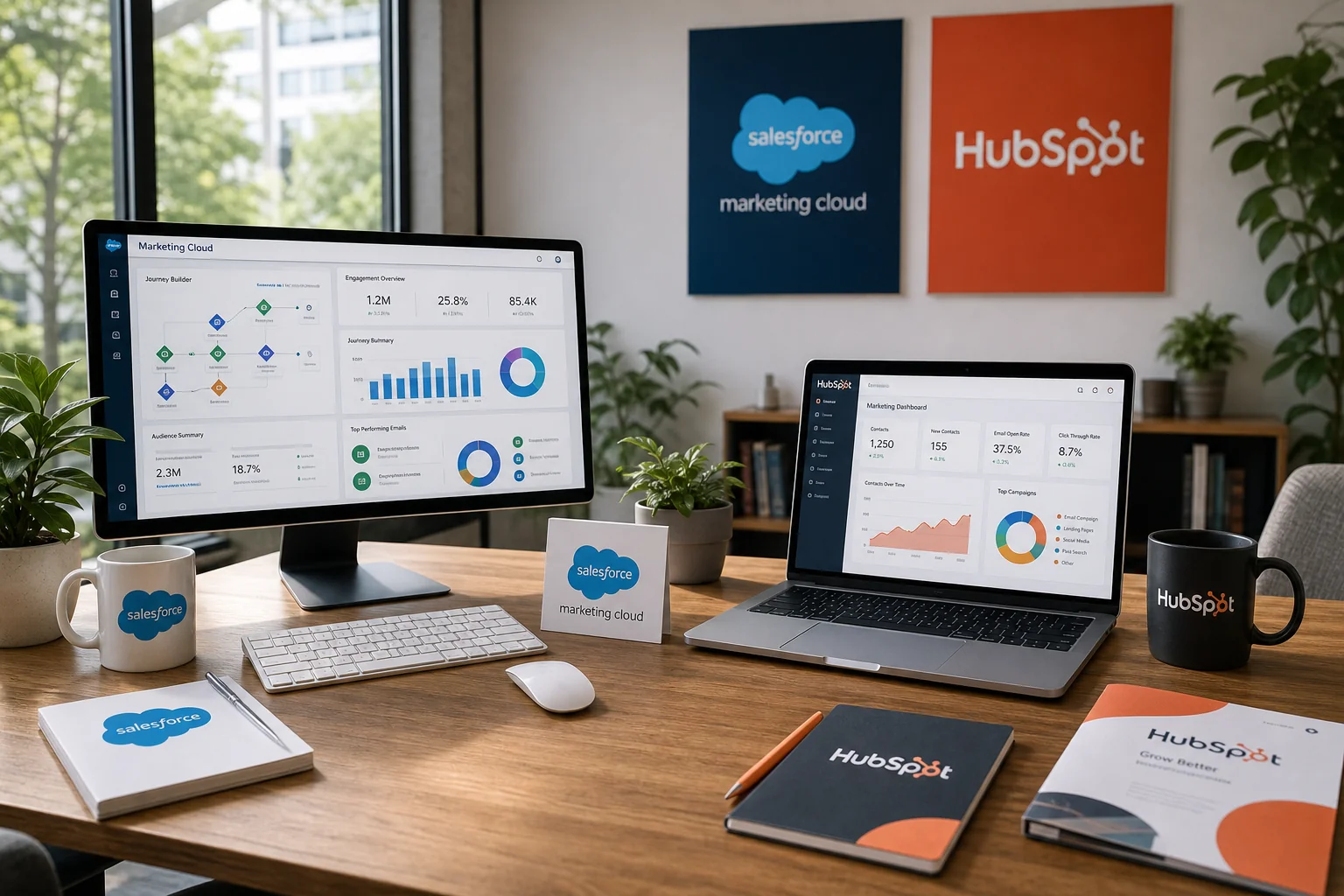
Modern office workspace split into two: Salesforce Marketing Cloud with vibrant analytics on one side, HubSpot's friendly das

Marketing Cloud Growth Edition vs
HubSpot: Choosing the Right Automation Platform

Choosing a marketing automation platform is a significant decision for a growing business. The right system can connect customer data, simplify campaign management, improve lead nurturing, and help marketing and sales teams work more effectively. The wrong choice can introduce unnecessary complexity, expensive integrations, and software costs that become difficult to justify.

When comparing Marketing Cloud Growth Edition vs HubSpot, mid-size teams need to look beyond feature lists and promotional claims. Both platforms offer marketing automation, customer segmentation, CRM connectivity, and AI-assisted capabilities, but their architecture, pricing structures, and implementation requirements differ.

Salesforce Marketing Cloud Growth Edition, now positioned within the Marketing Cloud Next product family, is particularly relevant to organizations working within the Salesforce ecosystem. HubSpot Marketing Hub provides an integrated marketing environment built around HubSpot's Smart CRM, with tools for campaign execution, lead management, and reporting.

This guide examines:

  • The differences in marketing automation, CRM integration, and AI capabilities.

  • Current pricing structures and the expenses beyond subscriptions.

  • Which platform better supports different mid-size business requirements.

  • How to evaluate implementation complexity, reporting, and long-term scalability.

The goal is not to declare a universal winner. It is to help marketing leaders choose a platform that fits their existing systems, team capabilities, budget, and customer acquisition strategy.

Understanding Salesforce Marketing Cloud
Growth Edition and HubSpot

Salesforce Marketing Cloud Growth Edition was introduced as a marketing automation solution built around Salesforce's core platform. Salesforce subsequently evolved the product into the Marketing Cloud Next family, with the current Growth offering marketed as Marketing Cloud Next Growth Edition. The platform combines customer data, campaign development, automated journeys, and AI-assisted marketing capabilities within Salesforce's broader ecosystem.

HubSpot Marketing Hub serves a similar overall purpose but approaches it through HubSpot's integrated CRM platform. It provides tools for email marketing, lead generation, segmentation, automated workflows, and marketing analytics. Its functionality varies by subscription tier, so a comparison with Salesforce Growth should focus on an appropriate HubSpot paid plan rather than treating the free CRM as equivalent.

Both platforms can support growing marketing teams, but they make the most sense in different operational environments. A company already using Salesforce for sales operations may benefit from keeping marketing processes within the same ecosystem. A business using HubSpot CRM or seeking a more consolidated marketing interface may find HubSpot a more natural choice.

Before evaluating either product, businesses should review their current technology stack and identify the processes they actually need to automate. Mass Data's guide to conducting a marketing automation audit explains how examining existing workflows, integrations, and data quality can reveal requirements that are easy to overlook during software selection.

Marketing Cloud Growth Edition
vs HubSpot Pricing in 2026

Pricing is one of the most important differences between the platforms, particularly for companies that need to manage subscription expenses alongside implementation and operational costs.

Salesforce lists Marketing Cloud Next Growth Edition pricing on its official pricing page, which should be confirmed directly before purchasing, as published rates change over time. The package is positioned to include marketing automation capabilities such as customer journeys, forms, landing pages, and AI-assisted marketing, though the exact feature set for the current edition should be confirmed on Salesforce's official pricing and product pages. Salesforce also offers Marketing Cloud Next Advanced Edition, which adds capabilities beyond the Growth package at a higher subscription price.

HubSpot Marketing Hub Professional has a published starting price that includes a set number of Core Seats and an initial allocation of marketing contacts, and Professional onboarding carries a separate one-time fee. These figures should be confirmed on HubSpot's current pricing page, as they are subject to change. Additional marketing contacts, seats, and products can increase the final subscription cost.

These figures reflect published US pricing and should be confirmed directly with each vendor before purchasing, as pricing and packaging change over time. Salesforce's official Marketing Cloud pricing provides current product positioning and package information. HubSpot also publishes detailed pricing and contract conditions, which businesses should review when requesting a comparable proposal.

Looking Beyond the Subscription Price

The advertised monthly cost is only one part of the investment. Salesforce's organization-based pricing does not mean every feature, message volume, data capability, or integration is included without additional charges. Similarly, HubSpot's pricing can increase as marketing contact volumes grow or teams require additional users and advanced products.

Implementation expenses also matter. Migrating existing contacts, configuring automated journeys, integrating external systems, and training employees can require specialist resources. A business with a mature Salesforce environment may face different setup requirements from one introducing Salesforce for the first time.

A fair comparison should consider the total first-year investment and the expected operating costs as the business grows. Mass Data's article on marketing automation cost in 2026 explains how subscriptions, onboarding, integrations, and ongoing management contribute to the actual cost of ownership.

Comparing Marketing Automation, Customer
Journeys, and AI Features

Diverse professionals collaborate in a modern office, discussing marketing automation on a digital screen, surrounded by tech

Both platforms help businesses automate customer communication, but the way those workflows are created and managed differs.

Salesforce Marketing Cloud Next Growth supports automated customer journeys, audience segmentation, forms, landing pages, and campaign development within Salesforce's platform. Its AI-assisted capabilities can support campaign content creation and related marketing tasks. However, businesses should distinguish between Growth and Advanced functionality, since more sophisticated conversational messaging, scoring, and other capabilities may require a different edition or additional products.

HubSpot Marketing Hub Professional provides workflow automation, email marketing, segmentation, lead nurturing, and campaign management in an integrated environment. Teams can use CRM information and behavioral triggers to initiate communications, update contact properties, and support the progression of leads through the buying process. Its automation capabilities are particularly relevant when marketing processes need to remain closely connected to HubSpot's CRM records.

Which Platform Supports More Advanced Automation?

The answer depends on the specific automation requirements rather than the number of features advertised. Salesforce may be particularly suitable for businesses seeking deeper alignment with an existing Salesforce data model and related applications. HubSpot can be attractive to teams that want marketing automation and CRM workflows managed through a connected application environment.

For example, a B2B organization may need automated lead qualification, sales notifications, and complex routing based on account ownership. Another company may prioritize email nurturing, website conversion forms, and straightforward customer segmentation. Both platforms can address parts of these requirements, but the exact configuration and licensing should be evaluated through practical demonstrations.

AI functionality should also be assessed critically. Automated content suggestions and campaign assistance may reduce repetitive work, but they do not guarantee improved conversion rates or customer acquisition costs. Businesses should select features that solve identified problems rather than purchasing the platform with the most extensive AI marketing claims.

CRM Integration and
Customer Data Management

CRM architecture can be the deciding factor when choosing between Salesforce and HubSpot. Marketing automation depends on accurate information about contacts, companies, customer interactions, and sales opportunities. When these records are inconsistent or distributed across disconnected systems, even sophisticated workflows can produce poor results.

Salesforce Marketing Cloud Next Growth is built around Salesforce's platform architecture, making it particularly relevant to organizations already using Salesforce CRM. Marketing and sales processes can operate within the broader Salesforce environment, although access to specific data sources and capabilities depends on configuration, permissions, and licensing.

HubSpot Marketing Hub is similarly integrated with HubSpot's Smart CRM. This enables marketing activities, contact properties, and relevant customer interactions to be managed within the HubSpot ecosystem. However, businesses using external sales platforms may require additional synchronization and configuration to maintain reliable customer information.

Integration Complexity and Data Ownership

A business already using Salesforce Sales Cloud should evaluate the benefits of extending its existing ecosystem before introducing a separate marketing platform. Conversely, a team running its sales and marketing processes in HubSpot may have little reason to introduce Salesforce unless it requires capabilities that justify the additional complexity.

Companies should also examine how data moves between systems, which platform owns specific records, and what happens when information changes. Duplicate contacts, inconsistent customer identifiers, and delayed updates can interfere with segmentation, automated communication, and reporting.

For businesses using several platforms, Mass Data's AI marketing automation and integration services focus on connecting CRM systems, marketing platforms, analytics tools, and automated processes. A reliable integration architecture can be more important than the number of features available within an individual platform.

Ease of Use,
Implementation, and Team Resources

Diverse professionals collaborate at a modern conference table, discussing charts and project plans in a bright, inviting off

The complexity of implementation should reflect the capabilities and resources of the team responsible for operating the platform. A mid-size organization with dedicated Salesforce administrators and developers can support a different technology environment from a smaller marketing department with limited technical resources.

HubSpot is often attractive to marketing teams seeking a unified interface for managing campaigns, contacts, and automated workflows. Many activities can be configured through visual tools rather than requiring extensive custom development. However, sophisticated automation, reporting, and integrations can still require technical expertise and careful planning.

Salesforce Marketing Cloud Next Growth provides access to the broader Salesforce ecosystem, which can be valuable when multiple departments already operate within that environment. At the same time, implementation may involve more complex decisions about data models, permissions, user access, and integration architecture. Existing Salesforce expertise can therefore materially influence the cost and difficulty of adoption.

Planning the Implementation Process

Whichever platform the business selects, implementation should begin with documented customer journeys and a clear understanding of the data needed to support them. Starting with a small number of meaningful workflows allows teams to test lead capture, segmentation, communication triggers, and sales handoffs before expanding the system.

For example, a company could begin with an inquiry form, an automated acknowledgment, lead assignment, and a relevant follow-up sequence. Once that process operates reliably, additional customer journeys can be introduced without creating unnecessary dependencies.

Mass Data's example diagram of an automated marketing system illustrates how lead capture, CRM management, segmentation, and automated communication connect. Mapping these relationships before choosing software helps businesses distinguish essential requirements from features they are unlikely to use.

Reporting, Attribution,
and Sales Alignment

Marketing automation platforms should help businesses understand whether their campaigns generate meaningful commercial results. Email engagement and campaign activity are useful operational metrics, but they do not necessarily reveal whether marketing produces qualified leads, sales opportunities, or additional revenue.

Salesforce Marketing Cloud Next Growth includes campaign attribution reporting capabilities within its broader product offering. Organizations using Salesforce CRM may benefit from connecting marketing activity with relevant customer and opportunity information, depending on the implemented configuration and available licenses.

HubSpot Marketing Hub Professional also provides marketing reporting and attribution capabilities, although some advanced analysis and reporting options are associated with higher subscription tiers. Businesses should verify whether the desired attribution reports, custom dashboards, and lifecycle metrics are available within the plan being evaluated.

What Mid-Size Teams Should Actually Measure

The reporting comparison should begin with business questions rather than dashboard design. A B2B organization may need to understand which campaigns generate qualified pipeline opportunities, while an ecommerce business might prioritize repeat purchases, customer acquisition efficiency, and retention.

It is important to distinguish CRM outcomes from analytics events and advertising-platform conversions. Different systems may report different results because of event definitions, attribution rules, or reporting periods. Those differences should be explained rather than automatically treated as tracking failures.

A capable marketing automation specialist can help define these measurement requirements, maintain integrations, and ensure that workflows remain connected to commercial objectives. Mass Data's article on the role of a marketing automation specialist examines the combination of technical, strategic, and analytical skills needed to manage these systems effectively.

Which Platform Is Better
for Different Mid-Size Teams?

Diverse team members discuss strategies at a conference table, surrounded by laptops and digital tools in a modern office.

There is no universally superior choice in the comparison of Marketing Cloud Growth Edition vs HubSpot. The right platform depends heavily on the systems already in use, the complexity of customer journeys, and the resources available for implementation and maintenance.

For a company with an established Salesforce environment, Marketing Cloud Next Growth may offer a more natural direction. Marketing activities can be developed within the existing platform architecture, reducing the need to introduce an entirely separate customer management ecosystem. However, the business must still confirm that the Growth package provides the required functionality and that the total cost is justified.

For a marketing-led organization using HubSpot CRM, Marketing Hub Professional may provide a more suitable combination of automation, campaign management, and reporting. Teams can build on existing customer data and workflows without necessarily introducing another major platform. This advantage becomes less clear if the organization requires extensive custom functionality that would increase implementation complexity or require additional products.

When Neither Platform Is the Best Fit

Some mid-size businesses do not require the breadth of either platform. A company focused primarily on straightforward email marketing may be better served by a more specialized product, particularly if CRM integration and complex customer journeys are not immediate priorities.

Others may already have several established systems that work effectively together. Replacing them with a new platform could introduce migration risks, training expenses, and operational disruption without delivering a corresponding business benefit.

The selection process should therefore begin with business needs and system requirements, not a preference for a particular vendor. Mass Data's marketing automation services support workflow design, lead nurturing, CRM integration, and ongoing optimization for organizations evaluating or improving their marketing infrastructure.

Hypothetical Example: Two Mid-Size
Companies With Different Needs

Consider two hypothetical B2B companies, each with approximately 75 employees and a growing marketing team. Both want to improve lead nurturing, automate repetitive tasks, and measure marketing's contribution to their sales pipeline. However, their existing systems and operational requirements are different.

The first company already uses Salesforce CRM for account management, sales opportunities, and customer records. Its sales team relies heavily on Salesforce data, and the organization has employees familiar with the platform. In this environment, Marketing Cloud Next Growth could be a logical option because it supports marketing processes within the existing Salesforce ecosystem. The company would still need to evaluate subscription costs, implementation requirements, and the suitability of Growth Edition features.

The second company uses HubSpot CRM for contact management, sales activity, and website inquiries. Its marketing team needs automated email nurturing, lead segmentation, campaign reporting, and better coordination with sales. HubSpot Marketing Hub Professional may be a more straightforward extension of the existing setup, provided the required workflows and reporting capabilities are included in its subscription.

How the Companies Should Evaluate Their Choices

Neither organization should select its platform solely because it is already using the corresponding CRM. Existing infrastructure matters, but future requirements and operational costs are equally important.

Both companies should test representative customer journeys, verify reporting capabilities, review integration requirements, and compare implementation proposals. They should also estimate the resources needed to maintain workflows after launch and determine who will be responsible for ongoing optimization.

These scenarios are hypothetical and do not represent actual Mass Data client results. They illustrate why platform selection should reflect existing systems, organizational capabilities, and specific business objectives rather than generic comparisons between software providers.

Common Mistakes When
Comparing Salesforce and HubSpot

Two professionals discuss Salesforce and HubSpot dashboards on a laptop in a modern office, illuminated by natural light.

One common mistake is assuming that Salesforce automatically offers more advanced automation simply because its ecosystem is associated with enterprise applications. Salesforce has several marketing products and editions, and not every capability advertised across the broader platform is included in Marketing Cloud Next Growth. Businesses should distinguish between the specific package under consideration and the wider range of Salesforce products.

The opposite assumption is equally problematic. HubSpot's accessible interface does not mean its marketing automation capabilities are limited to simple email sequences. Higher-tier plans support sophisticated workflows and campaign management, although the exact functionality depends on the purchased edition and configuration.

Another mistake is comparing the Salesforce Growth subscription with HubSpot's free CRM tools. These are not equivalent products and do not provide a meaningful basis for evaluating automation functionality or total ownership costs. A more useful comparison involves the specific subscription tiers and additional services required to deliver the intended customer journeys.

Finally, companies sometimes prioritize feature lists without evaluating data quality, internal resources, and actual workflow requirements. A technically impressive platform can still produce disappointing outcomes when customer records are inconsistent, automation triggers are poorly designed, or nobody is responsible for monitoring performance.

Conclusion

A bright office with two workstations: one sleek and modern for Salesforce, the other vibrant for HubSpot, promoting collabor

Choosing between Marketing Cloud Growth Edition vs HubSpot requires more than comparing automation features or subscription prices. Both platforms can support customer communication, lead nurturing, and marketing operations, but their value depends on how well they fit the business's existing infrastructure and future requirements.

Salesforce Marketing Cloud Next Growth is worth considering for organizations invested in the Salesforce ecosystem and seeking closer alignment between marketing and customer data. HubSpot Marketing Hub offers a compelling alternative for businesses using HubSpot CRM or looking for an integrated environment to manage marketing campaigns and automation.

Before making a commitment, document the workflows your team needs, verify the features included in each plan, and calculate the full cost of implementation and ongoing management. A practical demonstration using representative customer data and business scenarios can reveal more about the suitability of each platform than a general feature comparison.

The best investment is the system your team can operate reliably, measure accurately, and use to improve meaningful business outcomes.

Questions
Answered

Common questions related to this topic.

What is marketing cloud growth edition vs hubspot?

Salesforce Marketing Cloud Growth Edition and HubSpot are both marketing automation platforms designed to help mid-size teams optimize their marketing efforts. The former focuses on advanced customer engagement and data-driven marketing strategies, while HubSpot offers a more integrated approach combining marketing, sales, and service tools in one platform.

How does marketing cloud growth edition vs hubspot work?

Salesforce Marketing Cloud Growth Edition uses sophisticated data analytics and segmentation to deliver targeted marketing campaigns, leveraging AI for enhanced personalization. In contrast, HubSpot provides a user-friendly interface for content creation, lead nurturing, and CRM features, making it easier for teams to manage their marketing strategies from one place.

What are the key benefits of Salesforce Marketing Cloud Growth Edition?

Salesforce Marketing Cloud Growth Edition offers advanced analytics, robust CRM capabilities, and deep integration with other Salesforce products. This makes it ideal for businesses looking to implement complex marketing strategies and track detailed customer interactions across multiple channels, enhancing overall marketing efficiency.

Can HubSpot help with lead nurturing?

Yes, HubSpot excels in lead nurturing by providing tools for email campaigns, automated workflows, and personalized content strategies. Its intuitive interface allows teams to engage potential customers effectively throughout their buyer's journey, making it a popular choice for mid-size marketing teams.

When should a team consider switching from HubSpot to Salesforce Marketing Cloud Growth Edition?

A team might consider switching when they need more advanced analytics, greater customization options, or if they are looking to scale their marketing efforts significantly. Salesforce Marketing Cloud Growth Edition can handle larger datasets and more complex marketing automation needs than HubSpot.

Should I use marketing cloud growth edition vs hubspot for my team?

Choosing between Salesforce Marketing Cloud Growth Edition and HubSpot depends on your team's specific needs. If your focus is on advanced data analytics and integration with other Salesforce tools, go for Marketing Cloud. However, if you need an all-in-one solution that's user-friendly, HubSpot might be the better option.

Free Strategy Call

Ready To GrowThis Into Results?

Compare Salesforce Marketing Cloud Growth Edition and HubSpot Marketing Hub for mid-size businesses. Explore 2026 pricing, marketing automation features, CRM integration, AI capabilities, implementation complexity, and reporting to determine which platform best supports your team's requirements.

✓Opportunity Assessment
✓Channel Review
✓Growth Recommendations
✓No Obligation
OR

Prefer to reach out directly? We'll get back to you as soon as possible.

Contact MASS DATA Today
Scroll to Top