MASS DATA - Google AI for Marketers

Performance Max vs Search Campaigns: When Each One Wins

Compare Performance Max and Search campaigns to understand when each works best. Explore targeting, automation, keyword control, conversion tracking, campaign overlap, and performance measurement to choose the right Google Ads strategy for ecommerce and lead generation.
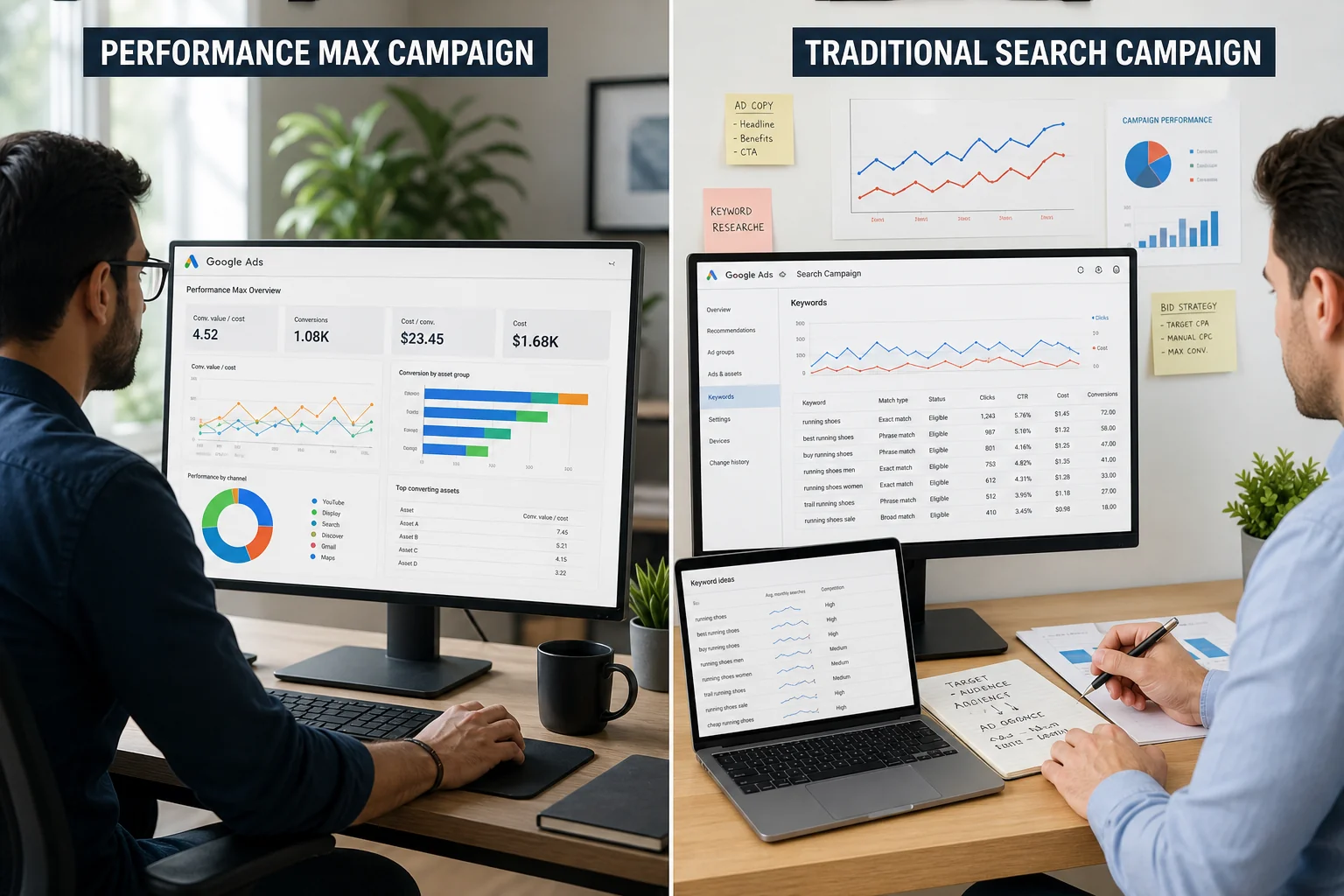
Split-screen image: Left shows a marketer analyzing Performance Max data; right features a strategist with search campaign to

Performance Max vs Search Campaigns: Choosing
the Right Strategy for Better Results

Choosing between Performance Max and Search campaigns is no longer a simple decision between automation and manual control. Both campaign types use Google's machine learning, both can generate valuable conversions, and both can play an important role in a profitable advertising strategy.

The real difference lies in how they find customers, where ads appear, and how much influence advertisers have over targeting, creative messaging, and budget allocation.

For businesses comparing Performance Max vs Search Campaigns, the right choice depends on their objectives, conversion data, available budget, and the level of control required. A campaign that works particularly well for an established ecommerce retailer may be less suitable for a B2B company trying to generate highly qualified leads.

This guide explains:

  • How Performance Max and Search campaigns differ in targeting, automation, and reporting.

  • When Search campaigns provide a stronger commercial advantage.

  • Which situations make Performance Max worth testing or scaling.

  • How to combine both campaign types without unnecessarily overlapping traffic.

  • Which metrics reveal whether campaigns are delivering genuine business value.

Rather than declaring one campaign type the universal winner, the goal is to identify which approach is most appropriate for different business situations.

Understanding Performance Max
and Search Campaigns

How Performance Max Campaigns Work

Performance Max is a goal-based Google Ads campaign type that uses automation to deliver ads across several Google advertising channels. These include Search, Shopping-related inventory, YouTube, Display, Discover, Gmail, and Maps.

Instead of managing individual keywords and placements in the traditional way, advertisers provide campaign objectives, conversion goals, creative assets, product feeds when relevant, and other strategic inputs.

Google's automation uses these inputs to determine which eligible opportunities may help achieve the campaign's objectives. Bidding, ad combinations, and delivery decisions are managed through Google's automated systems.

For an ecommerce business, this might involve showing product ads to people searching for specific items while also reaching other potential customers through Google's wider advertising inventory.

Performance Max is not simply a prospecting campaign. It can reach people at different stages of the buying journey, including existing customers and users searching for the advertiser's brand, depending on campaign settings and eligibility.

How Search Campaigns Work

Search campaigns focus on capturing demand from people actively searching for products, services, or information.

Advertisers organize campaigns around keywords, ad groups, and relevant landing pages. Keywords can use exact, phrase, or broad match, while responsive search ads adapt combinations of supplied headlines and descriptions to eligible searches.

Search campaigns also benefit from automation. Smart Bidding can optimize bids using auction-time signals, while broad match and AI-powered features can expand beyond narrowly defined search terms.

The difference is that advertisers retain a more explicit keyword-led structure and greater control over which searches they intend to target.

Mass Data's article on how Google AI helps marketers maximize Search ad performance provides additional context on automated bidding, responsive ads, and machine learning in paid search.

Performance Max vs Search
Campaigns: The Differences That Matter

The most important distinction is the scope of advertising inventory.

Search campaigns primarily target people using Google Search and eligible search partners, with additional reach depending on campaign settings. Performance Max can deliver advertising across multiple Google channels within a single campaign.

This wider reach allows Performance Max to identify conversion opportunities beyond explicit keyword searches. However, it also means that campaign performance combines several types of advertising interactions.

Search campaigns offer more direct control over keyword selection, search-term exclusions, ad-group structure, and search-focused messaging.

Performance Max uses asset groups, audience signals, search themes, automated creative combinations, and other campaign controls. Search themes help guide the system toward relevant queries, but they do not behave exactly like conventional keyword targeting.

Another important distinction is transparency.

Search campaigns provide detailed keyword-level reporting that can help advertisers identify which search queries are attracting customers. Performance Max also offers search-term reporting and channel performance reporting, providing greater visibility than earlier versions of the campaign type. However, advertisers still do not receive the same level of granular control over every placement and delivery decision.

 
Google Ads Help+1

Neither campaign type automatically produces higher-quality traffic. Results depend on campaign configuration, conversion measurement, market conditions, and the commercial value of the customers being acquired.

When Search Campaigns
Are the Better Choice

A plumber in uniform fixes a leak outside a Manchester home, while an anxious homeowner watches, highlighting urgency and pro

Search campaigns are particularly valuable when advertisers want to capture clearly defined customer intent.

Consider a business offering emergency plumbing services. Someone searching for "emergency plumber in Manchester" is expressing a specific need, often with immediate commercial intent.

A tightly structured Search campaign can target that demand with relevant advertisements, geographic settings, and landing pages designed to generate phone calls or appointment requests.

This level of precision is also useful for B2B lead generation, specialized professional services, and businesses where certain searches are far more valuable than others.

High-Intent Lead Generation

For businesses with long sales cycles, generating more conversions does not necessarily mean acquiring better customers.

A software company may receive many low-cost leads from broad advertising campaigns, but only a small proportion might meet its qualification requirements.

Search campaigns can provide a useful starting point because advertisers can focus on searches that indicate purchase intent, product evaluation, or demand for a specific service.

The ability to analyze individual search terms also helps marketers distinguish relevant prospects from informational or unsuitable traffic.

Restricted Budgets and Messaging Requirements

Search campaigns can be attractive when advertising budgets are limited and the business wants to concentrate on its most valuable search opportunities.

They are also useful when advertisers need close control over advertising language, particularly in industries with strict compliance requirements or carefully defined service offerings.

This does not mean Search guarantees efficient spending. Broad match, automated bidding, poor landing pages, and weak conversion signals can still produce disappointing results.

However, Search provides a more focused structure for diagnosing these problems.

For businesses evaluating paid search opportunities, Mass Data's Google Ads management services cover Search, Shopping, Performance Max, conversion tracking, and campaign optimization within a broader performance strategy.

When Performance Max
Campaigns Have the Advantage

Performance Max becomes particularly interesting when businesses have reliable conversion data, sufficient commercial demand, and opportunities to reach customers across multiple advertising environments.

For ecommerce retailers, product feeds can be especially valuable. A well-maintained Merchant Center feed supplies product information that helps Google match eligible products with relevant advertising opportunities.

Performance Max can also combine feed-based advertising with additional creative assets, allowing businesses to reach potential customers through different formats.

Ecommerce Businesses With Product Catalogs

An online retailer selling hundreds of products may find it difficult to create and maintain separate keyword campaigns for every product category, variation, and emerging search opportunity.

Performance Max can use product information, landing pages, creative assets, and conversion signals to identify potentially valuable traffic across Google's inventory.

However, feed quality matters. Incorrect prices, disapproved products, outdated availability, and weak product descriptions can limit campaign effectiveness regardless of how sophisticated the bidding system is.

A retailer should therefore treat Merchant Center maintenance as part of campaign management, not as a one-time technical setup.

Businesses With Reliable Conversion Value Data

Performance Max can be especially useful when the advertiser measures not only whether a conversion occurred but also how valuable that conversion was.

For example, a retailer selling products at significantly different price points may benefit from optimizing toward conversion value rather than treating every purchase as equally valuable.

For lead generation, the same principle applies when qualified leads or sales outcomes can be measured and used appropriately.

Automated optimization is only as commercially useful as the goals and values supplied to it.

Mass Data's guide to what marketers need to learn about Google Ads AI explores why successful automation requires strategic decisions about conversion goals, bidding, creative assets, and measurement.

How Performance Max and
Search Campaigns Work Together

A modern digital marketing workspace with dual screens showing analytics, a notepad, coffee, and a plant, bathed in natural l

Many businesses do not need to choose one campaign type exclusively.

Search campaigns can capture clearly identified demand, while Performance Max can explore additional conversion opportunities across Google's inventory.

However, using both requires an understanding of campaign prioritization.

Google does not simply give every Search campaign priority over Performance Max.

According to Google's official guidance on how Performance Max interacts with other campaigns, eligible Search campaigns containing an exact match keyword identical to the user's query, including qualifying spelling corrections, receive priority over Performance Max.

Other overlapping opportunities may be determined by additional prioritization rules and Ad Rank.

This distinction matters when advertisers assume that placing a keyword in a Search campaign automatically prevents Performance Max from serving on related queries.

Protecting Brand Traffic

Brand searches often perform differently from generic searches because users may already know the company and be close to purchasing.

If an advertiser measures branded and non-branded activity together, campaign results can appear stronger without necessarily demonstrating that the campaign acquired additional customers.

Dedicated brand Search campaigns can provide clearer visibility into this demand.

Performance Max brand exclusions and other appropriate controls can help advertisers manage unwanted overlap. These settings should be configured carefully to avoid unintentionally restricting valuable traffic.

Managing Budget Allocation

Running both campaign types does not mean splitting the budget equally.

The allocation should depend on profitable demand, available conversion data, business priorities, and the ability of each campaign to produce valuable outcomes.

A company might initially prioritize Search campaigns that consistently generate qualified leads. As tracking improves and additional opportunities emerge, it can test Performance Max using a separate budget.

For an established ecommerce business, the balance may be different.

The objective is to understand how both campaigns contribute to overall performance rather than treating them as isolated competitors.

Conversion Tracking Is More
Important Than Campaign Type

One of the biggest mistakes in Google Ads is comparing campaigns before confirming that they are optimizing toward meaningful outcomes.

For ecommerce businesses, accurate purchase values, transaction identifiers, and correctly configured conversion actions are essential.

For lead generation, the challenge can be more complex.

A submitted form may indicate interest, but it does not necessarily represent a qualified prospect. If automated bidding optimizes primarily for low-quality submissions, a campaign can report an attractive cost per lead while producing limited commercial value.

This problem can affect both Performance Max and Search campaigns.

A useful measurement framework distinguishes between:

  • Primary conversions: Business outcomes selected to guide bidding.

  • Secondary conversions: Additional actions measured for analysis without automatically being used as primary optimization goals.

  • Qualified leads: Inquiries that meet defined commercial or sales criteria.

  • Conversion value: The value assigned to a measured outcome, ideally reflecting actual business value.

  • Backend or CRM outcomes: Verified purchases, accepted leads, opportunities, and revenue recorded in business systems.

The exact configuration depends on the business model and the available data.

It is also important not to confuse attribution with conversion tracking. Different reporting systems can assign credit differently even when the underlying transaction is recorded correctly.

Search campaigns do not automatically use last-click attribution while Performance Max uses a different model. Attribution is determined by applicable conversion-action settings and reporting logic, not simply by the campaign type.

 
Google Ads Help

Mass Data's guide to Google Ads conversion tracking explains how unreliable data can distort automated bidding and lead advertisers toward misleading optimization decisions.

Practical Optimization Strategies
for Both Campaign Types

A modern digital marketing workspace with a laptop, analytics charts, sticky notes, and a whiteboard filled with strategies.

Effective optimization begins with understanding the role each campaign plays within the account.

For Search campaigns, this means reviewing search terms, identifying irrelevant traffic, improving responsive search ads, and ensuring that landing pages match the intent behind targeted searches.

Keyword performance should be evaluated alongside conversion quality and profitability. A keyword with a high conversion rate may still be commercially weak if it attracts low-value customers.

Performance Max requires a different optimization workflow.

Advertisers should review asset-group structure, product feed performance, search themes, brand exclusions, negative keywords, landing-page selection, conversion goals, and channel reporting.

The availability of campaign-level negative keywords and more detailed search-term reporting gives advertisers additional ways to identify and restrict irrelevant traffic. However, negative keywords should be applied carefully because overly restrictive exclusions can remove useful conversion opportunities.

 
Google Ads Help

Channel performance reports also help advertisers understand where Performance Max activity is occurring, rather than evaluating the campaign as a single undifferentiated source of traffic.

Google has additionally begun rolling out channel prioritization and budget allocation controls for eligible campaign types. Availability may differ between accounts during the rollout, and these controls do not replace a clear campaign strategy.

 
Google Ads Help

For both campaign types, optimization should focus on the relationship between advertising cost, conversion quality, and actual business outcomes.

A campaign that generates more conversions is not necessarily the stronger campaign if those conversions contribute less profit or revenue.

Measuring Performance Max
vs Search Campaigns Fairly

A meaningful comparison requires more than looking at ROAS, CPA, or conversion volume in two campaign rows.

First, confirm that the campaigns are being measured against appropriate objectives.

Comparing a Search campaign focused on branded queries with a Performance Max campaign serving multiple channels and mixed customer segments may produce misleading conclusions.

Brand demand, prospecting activity, product margins, and customer acquisition goals should all be considered.

For ecommerce, revenue and ROAS are useful indicators, but they do not automatically reveal profitability. Product margins, discounts, returns, fulfillment costs, and the proportion of existing customers can influence the real financial outcome.

For lead generation, cost per qualified lead, opportunity creation, and customer acquisition cost often provide more meaningful information than cost per form submission alone.

Campaign comparisons should also account for changes in budgets, bidding targets, seasonality, conversion settings, and landing pages.

When testing a new campaign type, use a controlled testing approach where possible. Avoid changing several major account settings simultaneously and then attributing every improvement to Performance Max or Search.

For agencies reporting across different campaign types, Mass Data's article on white-label Google Ads reporting explains the importance of connecting advertising metrics with business outcomes and clear reporting context.

Why Incrementality Matters

A campaign may receive credit for conversions that would have occurred through another campaign or marketing channel.

For example, Performance Max may report strong results after serving ads to existing customers already familiar with the brand.

That does not automatically mean all reported revenue was additional revenue created by the campaign.

Where practical, advertisers can use structured experiments, geographic comparisons, or other suitable testing methods to evaluate whether changes create incremental business value.

This is particularly relevant when deciding whether to shift substantial budgets between existing Search campaigns and Performance Max.

Hypothetical Example: Ecommerce
vs B2B Lead Generation

A split image: left shows a vibrant online retail space with premium running shoes; right features a collaborative B2B office

Consider two hypothetical businesses with different objectives.

The first is an online retailer selling premium running shoes. It has an established product catalog, functioning Merchant Center feed, accurate purchase tracking, and several months of reliable conversion data.

The company already runs Search campaigns targeting specific brands and high-intent product searches.

Rather than replacing those campaigns, it introduces Performance Max to explore additional conversion opportunities through product advertising and Google's wider inventory.

The retailer monitors revenue, ROAS, product-level performance, and the distribution of branded and non-branded demand.

If Performance Max generates valuable additional sales without undermining existing campaign profitability, the company may gradually allocate more budget to it.

Now consider a B2B company offering specialized accounting software to enterprise customers.

The business receives relatively few leads, and sales cycles can last several months.

In this situation, Search campaigns may be the better initial investment because they allow the company to target specific commercially relevant queries and evaluate the quality of incoming leads.

A Performance Max test could still be appropriate, particularly if the company has reliable CRM feedback and enough conversion data to support optimization.

However, the company should not assume that lower reported lead costs automatically indicate stronger commercial performance.

Neither scenario represents actual Mass Data client results. They illustrate why campaign selection should follow the business model rather than a universal preference for automation.

Common Mistakes When
Choosing Between Campaign Types

One common mistake is assuming that Performance Max always performs better because it uses more automation.

Search campaigns also use machine learning, particularly through Smart Bidding and modern keyword matching. Greater automation does not eliminate the need for accurate goals and effective campaign management.

Another mistake is treating Performance Max as a replacement for every existing Search campaign.

This can reduce visibility into high-intent keyword performance and make it harder to evaluate how different customer segments contribute to results.

The opposite approach can also be limiting. Businesses that rely exclusively on tightly controlled Search campaigns may miss opportunities available through product-based advertising and other Google channels.

Finally, advertisers sometimes judge a campaign based on short-term fluctuations without considering conversion delays, normal performance variation, or changes to measurement.

For businesses experiencing inconsistent reporting, Mass Data's conversion tracking audit helps identify issues across Google Ads, GA4, GTM, and related measurement systems.

Conclusion

A split-screen image contrasting a data-focused Search Campaign with a vibrant, creative Performance Max brainstorming sessio

The decision between Performance Max vs Search Campaigns should begin with business objectives rather than a preference for automation or manual control.

Search campaigns are often the stronger choice when advertisers need keyword precision, clearer control over search intent, and focused lead generation. Performance Max can offer advantages when businesses have reliable conversion data, strong creative and product inputs, and opportunities to generate value across multiple Google channels.

For many advertisers, the most effective approach is a carefully managed combination of both.

The priority is to build an account structure that captures valuable demand, identifies additional growth opportunities, and measures results accurately.

Start by reviewing your current conversion data, the commercial value of different customer segments, and the performance of existing campaigns. Then test campaign structures against clearly defined business outcomes before making major budget changes.

Questions
Answered

Common questions related to this topic.

What is performance max vs search campaigns?

Performance Max is a campaign type that leverages machine learning to optimize ad delivery across various Google channels, while Search Campaigns focus on displaying ads based on specific keywords in search results. For example, Performance Max can serve ads on YouTube and Display networks, maximizing reach based on conversion goals.

How do performance max vs search campaigns differ in targeting?

Performance Max uses audience signals to target users across multiple platforms, while Search Campaigns rely heavily on keyword targeting based on user queries. This means that Performance Max can adapt to different formats and channels, making it more flexible, whereas Search Campaigns provide precise control over keyword bids.

When should I use Performance Max instead of Search Campaigns?

Use Performance Max when you want to maximize conversions across various Google channels with less manual management. In contrast, opt for Search Campaigns if your strategy requires precise control over keywords and specific targeting based on search intent.

Can Performance Max campaigns outperform traditional Search Campaigns?

Not necessarily. While Performance Max Campaigns can be highly effective due to their automated nature, their performance depends on factors like campaign goals, audience insights, and product types. For some specific campaigns, Search Campaigns may still deliver better results due to their focused approach.

What are the main advantages of Search Campaigns?

Search Campaigns offer precise targeting through keyword selection, allowing advertisers to reach users actively searching for specific products or services. Additionally, they provide clear data on performance, making it easier to track ROI compared to the broader approach of Performance Max.

Should I combine both Performance Max and Search Campaigns in my strategy?

Yes, combining both can be beneficial. Using Search Campaigns allows you to capture intent-driven traffic, while Performance Max can help reach a wider audience across multiple platforms. This integrated approach can enhance overall campaign effectiveness and optimize ad spend.

Free Strategy Call

Ready To GrowThis Into Results?

Compare Performance Max and Search campaigns to understand when each works best. Explore targeting, automation, keyword control, conversion tracking, campaign overlap, and performance measurement to choose the right Google Ads strategy for ecommerce and lead generation.

✓Opportunity Assessment
✓Channel Review
✓Growth Recommendations
✓No Obligation
OR

Prefer to reach out directly? We'll get back to you as soon as possible.

Contact MASS DATA Today
Scroll to Top