
MASS DATA — AI Marketing Automation

AI Lead Qualification: How It Works Beyond the Vendor Pitch

Discover how AI lead qualification works and its real benefits for your business. Learn more today!

AI lead qualification how it works is an essential consideration for businesses aiming to enhance their sales processes. By leveraging AI technologies, marketing operations managers and small business owners can efficiently identify and prioritize leads that are most likely to convert. However, understanding the mechanics behind AI lead qualification is crucial to avoid falling for vendor hype and to implement effective strategies.

Key Takeaways
AI lead qualification utilizes algorithms to assess lead quality based on various data points.
Implementing AI tools can streamline the qualification process and improve conversion rates.
Customizing lead scoring models to specific business needs is essential for effectiveness.
A vibrant futuristic office with diverse professionals analyzing AI-driven data on sleek interfaces, surrounded by holographi

What is AI Lead
Qualification and How It Works?

AI lead qualification is the process of using artificial intelligence to evaluate and prioritize potential customers based on their likelihood to convert into paying clients. This technology streamlines the sales funnel by automating lead scoring and assessment, allowing businesses to focus on high-potential leads.

Key Components of AI Lead Qualification

Several key components underpin the AI lead qualification process:

  • Data Collection: AI tools gather data from various sources, including CRM systems, website interactions, and social media activity. This data forms the basis for understanding lead behavior and preferences.
  • Natural Language Processing (NLP): NLP enables AI to interpret and analyze user interactions, particularly in chatbots and customer support, facilitating more personalized engagement.
  • Predictive Analytics: By analyzing historical data, AI can predict future behavior, assessing the likelihood of leads converting based on past interactions.

Benefits of
AI Lead Qualification

Implementing AI lead qualification can enhance your marketing strategy in several ways:

Improved Conversion Rates

AI lead qualification helps prioritize leads based on their likelihood to convert, thereby increasing conversion rates. Through lead scoring, AI evaluates leads using various criteria, such as:

  • Engagement Levels: Frequency of interactions with your content.
  • Demographic Information: Age, location, and other relevant data.
  • Behavioral Data: Actions taken on your site or in previous campaigns.

For example, when a lead fills out a contact form, the AI tool analyzes their previous interactions with your site and scores them accordingly. If they have engaged with your content multiple times, they may be prioritized for follow-up, increasing the chances of conversion.

Enhanced Efficiency in Lead Management

AI can significantly enhance your team’s efficiency in managing leads. By automating tedious tasks, such as data entry and initial lead assessments, it allows your team to focus on high-value activities. Here’s how AI achieves this:

  • Automation of Data Entry: AI tools can pull data from various sources, minimizing manual input errors.
  • Real-Time Scoring Adjustments: AI continuously updates lead scores based on new interactions, ensuring your team always has the latest information.
  • Integration with CRM Systems: AI integrates seamlessly with platforms like HubSpot or Klaviyo. When a lead fills out a form, this can trigger an automated workflow that updates their status in your CRM.

These efficiencies not only save time but also help in making informed decisions quickly. As you implement AI lead qualification, remember that it complements rather than replaces human judgment, allowing your team to focus on strategic tasks.

How to Implement
AI Lead Qualification

A diverse team collaborates in a modern office, engaged around a digital screen with vibrant data visualizations and AI icons

Assessing Your Current Lead Qualification Process

Before integrating AI into your lead qualification efforts, evaluate your existing process. Identify the criteria you currently use to assess leads, such as demographic information, engagement levels, and behaviors. Consider the following steps:

  1. Map Your Process: Document each stage of your lead qualification process from initial contact to conversion. This helps in understanding where AI can add value.
  2. Identify Pain Points: Look for areas where your current process is slow or ineffective. For instance, if manual lead scoring takes too much time, that’s a potential opportunity for automation.
  3. Gather Data: Ensure you have quality data on your leads. AI relies heavily on historical data to make predictions. If your data is outdated or incomplete, it can skew results.

Selecting the Right AI Tools for Integration

Once you have a clear understanding of your current process, the next step is to choose the right AI tools. Here are some factors to consider:

  1. Compatibility: Ensure the AI tool can seamlessly integrate with your existing CRM, such as HubSpot or Klaviyo. For example, HubSpot AI features like predictive lead scoring can be directly incorporated into your workflows.
  2. Functionality: Look for tools that offer specific capabilities relevant to your needs. If you require natural language processing for chatbots, ensure the AI tool supports it.
  3. Automation Ability: Choose tools that can automate repetitive tasks. For instance, when a lead fills out a form on your website, the AI can score the lead and trigger follow-up actions automatically.
  4. Customization: AI lead qualification tools should allow for customization of scoring models to fit your business context. Generic models may not yield accurate predictions.
  5. Data Privacy: With increasing regulations, select tools that prioritize data privacy and compliance.

Best Practices for
AI Lead Qualification

Customizing Lead Scoring Models

Understanding how AI lead qualification works involves recognizing that a one-size-fits-all approach to lead scoring simply doesn’t exist. Each business has unique characteristics and customer profiles that influence what makes a lead valuable.

  • Define Criteria: Start by identifying the key attributes of your ideal customer. This could include demographic information, engagement history, and specific actions (like website visits or email opens).
  • Use Historical Data: Leverage existing data to inform your scoring system. Look at past conversions to determine which behaviors correlate with successful leads.
  • Adjust Regularly: AI models are not static. Continuously refine your scoring criteria based on new data and market changes. For example, if you notice that leads from a specific industry are converting at higher rates, adjust your model to prioritize these leads.

Ensuring Data Quality and Compliance

Effective AI lead qualification relies heavily on the quality of your data. Poor data can lead to inaccurate lead scoring, wasting time and resources.

  • Data Cleaning: Regularly audit your data for accuracy. Remove duplicates and correct any inconsistencies. For instance, if a lead’s email address appears in multiple formats, standardize it to ensure consistency.
  • Compliance Considerations: Be mindful of data privacy regulations like GDPR and CCPA. Ensure that your lead qualification processes comply with these laws. This might involve obtaining explicit consent from leads before collecting their data or providing options for them to opt out of data collection.
  • Integrate Tools: Use platforms like HubSpot or Klaviyo that have built-in compliance features. These tools can help manage consent and ensure that your data practices align with legal requirements.

Common Challenges in
AI Lead Qualification
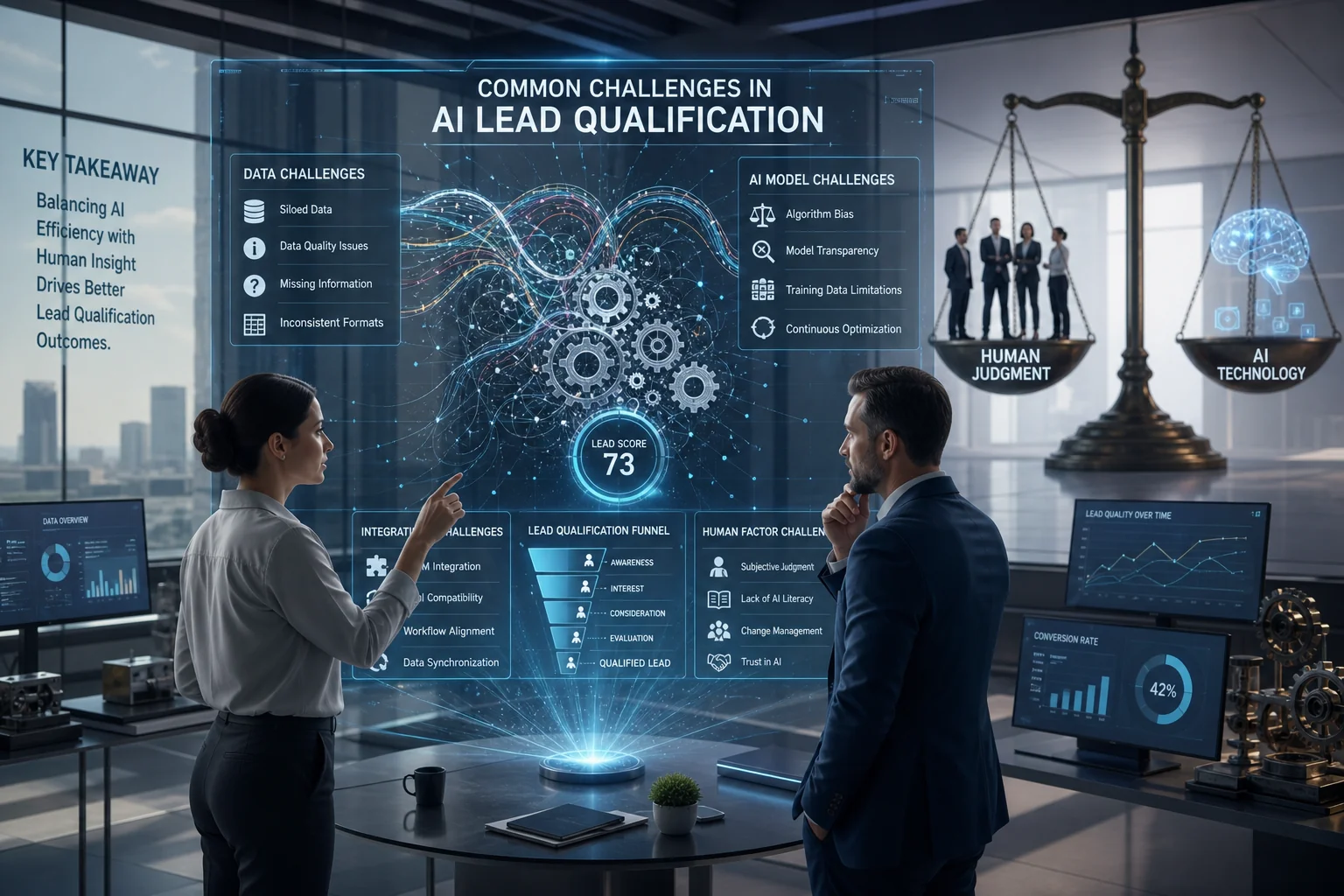
A futuristic office scene shows a marketing manager and small business owner interacting with a holographic display of lead m

While AI lead qualification can streamline the process of assessing and prioritizing leads, several challenges can impact its effectiveness. Understanding these challenges is crucial for marketing operations managers and small business owners looking to implement AI tools in their workflows.

Misconceptions About AI Capabilities

One common misconception about AI is that it can fully replace human judgment in lead qualification. While AI can analyze data and provide insights, it should be viewed as a supportive tool rather than a replacement for human decision-making. For example, AI can identify patterns in data, but it cannot understand the nuances of human interaction or the context behind a lead's behavior.

Another misconception is that a one-size-fits-all lead scoring model is effective for every business. In reality, the scoring model should be tailored to the specific needs of each organization. Factors like industry, target audience, and customer behavior can significantly affect how leads should be scored.

Additionally, many expect immediate results after implementing AI tools. However, effective AI lead qualification requires time for data training and model refinement. Initial outcomes may not reflect the long-term benefits of a well-tuned AI system.

Managing Data Quality Risks

Data quality is a significant concern when implementing AI lead qualification. Poor data quality can lead to inaccurate predictions and ineffective lead scoring. Businesses should ensure that their data is clean, consistent, and up-to-date before integrating AI tools.

For instance, if a lead fills out a form but provides incorrect information, this can skew the AI’s assessment of that lead's potential. Regular data audits and validation processes are essential to maintain the integrity of the lead qualification process.

Moreover, when using platforms like HubSpot or integrating with tools such as Klaviyo or Zapier, it’s crucial to establish clear data governance practices. This includes setting protocols for data collection, storage, and usage to minimize risks associated with data quality.

Tools and Resources
for AI Lead Qualification

Overview of HubSpot AI Features

HubSpot provides several AI capabilities designed to enhance lead qualification. HubSpot offers lead scoring capabilities that can help assess the likelihood that a lead will convert. Check HubSpot's current documentation to confirm which scoring features and data inputs are available on your plan before relying on them. For example, when a lead fills out a form on your website, HubSpot can analyze their behavior and automatically assign a score based on how closely they match your ideal customer profile.

Additionally, HubSpot provides workflow and automation features that can be configured to act on lead behavior. Consult HubSpot's documentation to confirm which triggers and actions are supported for your account before building these workflows. However, it’s essential to remember that while these tools can streamline processes, they still require human oversight to ensure that lead qualification aligns with your specific business goals.

Integrating AI with CRM Tools like Zapier and Make

Integrating AI capabilities with CRM tools like Zapier and Make can further enhance your lead qualification process. These platforms allow you to connect various applications, automating tasks without the need for complex coding.

Integration platforms like Zapier and Make can connect tools such as HubSpot and Klaviyo so that an event in one application can trigger an action in another. The specific triggers, actions, and sync speeds vary by platform and plan, so review each tool's current documentation to confirm what your setup supports.

While these integrations are powerful, there are limitations. Data quality is crucial; if the information entering your systems is inaccurate, it can skew the lead qualification process. Therefore, it's vital to ensure that your data sources are reliable and that your workflows are designed to handle exceptions effectively.

Hypothetical Example of AI
Lead Qualification in Action
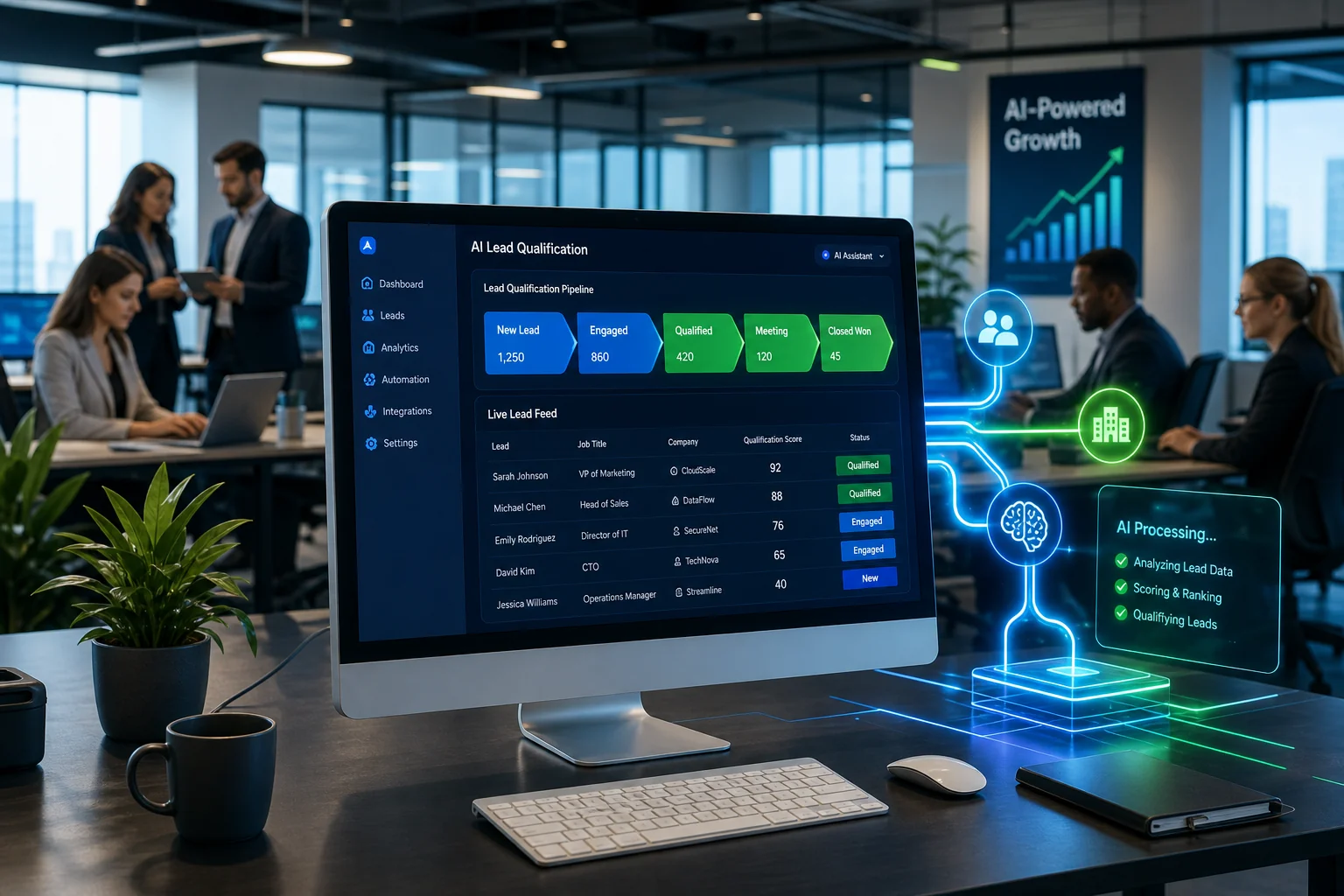
Futuristic office scene with an AI system on a sleek screen visualizing lead qualification, surrounded by diverse professiona

Scenario: A SaaS Company’s Lead Management

Imagine a SaaS company that provides project management software. The company uses HubSpot to manage its leads. When a potential customer fills out a form on their website, this action triggers an automation in HubSpot, marking the lead as "new."

Once classified as new, the AI lead qualification system begins its process. It analyzes the lead's information, such as job title, company size, and engagement with previous content. Based on these criteria, the system assigns a lead score. The higher the score, the more likely the lead is to convert into a paying customer.

Automation Triggers and Workflows

After scoring, the lead enters a workflow designed to nurture it further. For instance:

  1. Email Follow-Up: The lead receives an automated email welcoming them and providing resources related to their specific interests. This email is tailored based on previous interactions, enhancing the relevance of the content.
  2. Behavior Tracking: The system continues to monitor the lead’s interactions, such as website visits and email opens. If a lead shows significant engagement, like visiting the pricing page multiple times, the AI updates the lead score accordingly.
  3. Sales Notification: When the lead reaches a predefined score threshold, the sales team is notified. This could trigger a personal outreach from a sales representative, increasing the chances of conversion.

This AI-driven approach allows the SaaS company to prioritize leads effectively without overwhelming their sales team. By automating initial communications and tracking engagement, the company can focus its resources on leads that are most likely to convert.

Conclusion

A diverse team collaborates around a digital screen displaying vibrant AI data visualizations in a modern, inviting office.

Understanding how AI lead qualification works is vital for optimizing your marketing efforts. We discussed the importance of integrating AI with CRM systems, the benefits of tailored lead scoring, and the practical steps to implementation. By recognizing the limitations and advantages of AI, businesses can make informed decisions that enhance their lead management processes.

Start by evaluating your current lead qualification strategy and consider integrating AI tools to streamline your operations. This proactive approach can lead to improved efficiency and higher conversion rates.

Questions
Answered

Common questions related to this topic.

What is ai lead qualification how it works?

AI lead qualification utilizes algorithms to analyze leads and prioritize them based on conversion potential. This process combines data from various sources to create a comprehensive view of each lead. For instance, a lead showing high engagement on multiple platforms may be ranked higher for follow-up.

How does ai lead qualification how it works work?

AI lead qualification works by integrating with existing CRM systems to assess leads based on specific criteria like behavior and demographics. This allows businesses to focus on high-potential leads. The key benefit is that it automates the scoring process, saving time and improving conversion rates.

Why should I consider AI for lead qualification?

Implementing AI for lead qualification can streamline your marketing efforts and improve efficiency. By automating the assessment of leads, your team can concentrate on those most likely to convert. Moreover, AI's ability to learn from data means it can continuously improve its accuracy.

Can AI lead qualification replace human judgment?

No, AI lead qualification is designed to assist rather than replace human judgment. While AI can analyze vast amounts of data quickly, human oversight is essential for nuanced decision-making. Combining AI insights with human experience leads to better outcomes.

When is the best time to implement AI lead qualification?

The best time to implement AI lead qualification is when your business has a substantial amount of historical data to inform the AI algorithms. This ensures that the AI can accurately learn from past customer behavior, leading to more effective lead scoring.

What tools can I use for AI lead qualification?

You can use AI lead qualification tools integrated within platforms like HubSpot AI, Klaviyo, and various predictive analytics software. These tools can help automate lead scoring and enhance your marketing efforts by providing actionable insights.

Free Strategy Call

Ready To GrowThis Into Results?

Discover how AI lead qualification works and its real benefits for your business. Learn more today!

Opportunity Assessment
Channel Review
Growth Recommendations
No Obligation
OR

Prefer to reach out directly? We'll get back to you as soon as possible.

Contact MASS DATA Today
Scroll to Top